UFC Parlay Tips: How to Build MMA Accumulators Worth Placing
 Available in US
UFC Parlays Offer Big Payouts — If You Respect the Math
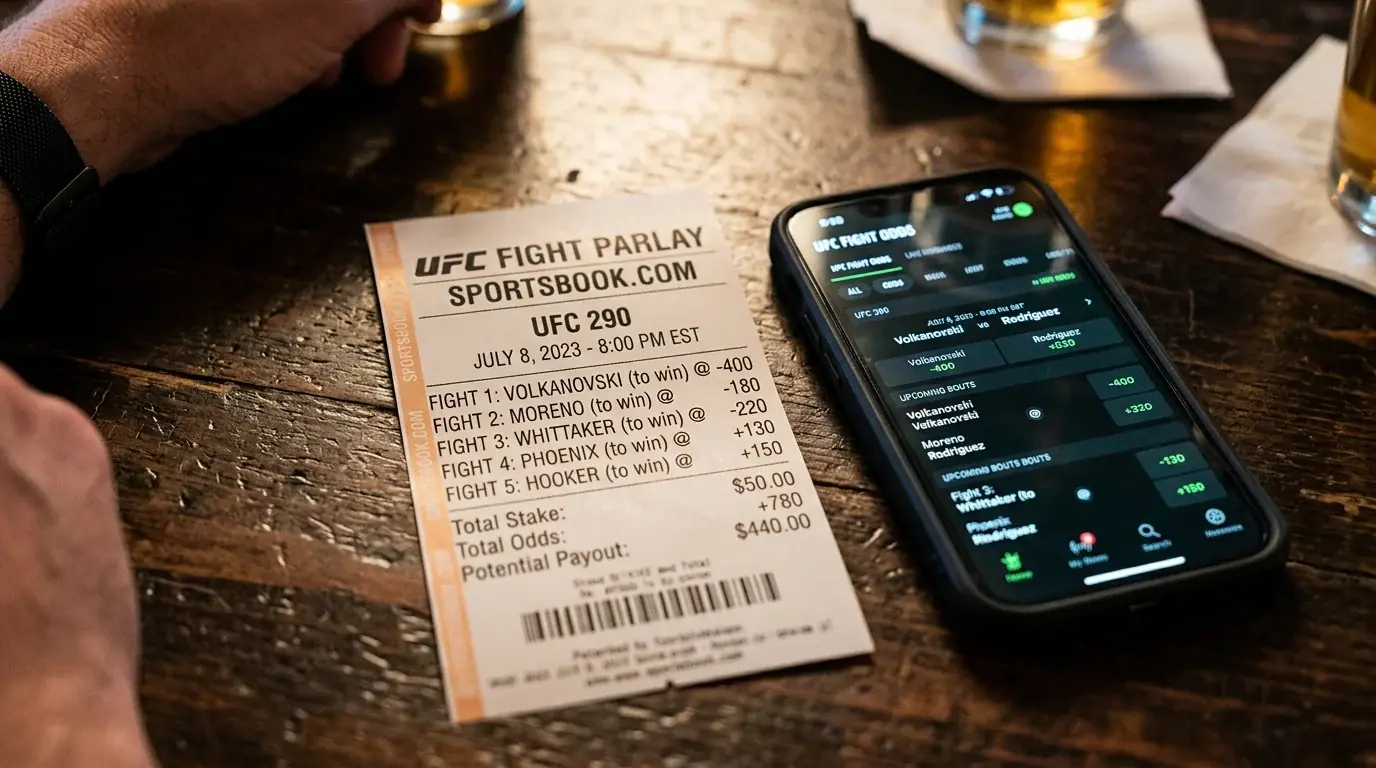
I placed my first UFC parlay in 2018 — three heavy favourites, all of them “locks.” Two landed. The third, a -450 moneyline that looked bulletproof on paper, got caught in a second-round guillotine. The entire ticket died. That evening taught me something every accumulator bettor eventually learns: parlays multiply risk just as aggressively as they multiply reward.
The appeal is obvious. MMA handle reached $10.3 billion in 2024, growing 17% year-on-year, and a huge slice of that volume comes from punters chasing the thrill of combining three, four, or five fight picks into a single slip. The maths are seductive — string together three selections at 1.50 decimal odds each and your combined price jumps to 3.375. A tenner returns over thirty quid. But the implied probability of landing all three drops to roughly 29.6%, even though each individual leg sits around 66.7%. That gap between “likely” and “all likely together” is where bankrolls go to die.
UFC parlays are not inherently bad bets. They become bad bets when you treat them the way most punters do — piling on favourites without thinking about how each leg interacts with the others. Over nine years of analysing MMA markets, I have found that the punters who profit from accumulators approach them with discipline, selectivity, and a healthy respect for compounding probability. This guide breaks down how to do exactly that.
See also: ufc betting tips for parlay and single-fight strategies.
How MMA Accumulator Bets Work
An accumulator — parlay in American English, multi-bet in Australia — bundles two or more individual selections into one wager. Every leg must win for the bet to pay out. Your bookmaker multiplies the decimal odds of each selection to produce a combined price, and your stake rides on the entire chain.
Say you back Fighter A at 1.80 and Fighter B at 2.10. The combined decimal odds are 1.80 x 2.10 = 3.78. A GBP 10 stake returns GBP 37.80 if both win, including your original tenner. Add a third leg at 1.65 and the combined price becomes 6.237 — your tenner now returns GBP 62.37. The payout scales fast, which is exactly why bookmakers love offering parlays: the house edge compounds with every leg you add.
In practical terms, a two-leg accumulator with each selection at 65% implied probability gives you a combined chance of about 42%. A three-legger drops to 27%. By four legs you are sitting at roughly 18%. These are not abstract numbers. They mean that even a well-researched four-fold parlay will lose more than four out of five times. The payout needs to compensate for that failure rate, and it often does not once you account for the bookmaker’s margin baked into each individual line.
Most UK platforms allow UFC parlays across the same event card. Some also permit same-fight parlays — combining moneyline, method of victory, and round totals within a single bout — though the correlation adjustments on these can eat into your edge significantly.
Choosing Parlay Legs: Correlation Over Quantity
The single biggest mistake I see in UFC parlays is leg hoarding — stuffing five or six “safe” favourites onto one ticket because each individual pick feels confident. Confidence is not additive. The overall finish rate in UFC sits at 53%, with KO/TKO accounting for 33.3% and submissions another 19.7%. In a sport where more than half the fights end before the judges’ scorecards, no moneyline is truly safe.
Instead of maximising legs, maximise correlation. Correlation means choosing selections that logically support each other rather than existing as independent coin flips. A heavyweight bout where both fighters carry knockout power and a combined 50% KO/TKO rate at the division level makes an “under 2.5 rounds” pick a natural companion to a moneyline on the more accurate striker. The two outcomes are not independent — if your fighter lands his power shots early, both legs win together. That shared pathway is the foundation of a smart accumulator.
Here is my framework for leg selection. First, identify one fight where I have a strong directional opinion backed by data — this is the anchor leg. Second, find a secondary market within that same fight or a stylistically similar matchup on the card that aligns with the same thesis. Third, if adding a third leg, choose a fight with a genuinely independent edge rather than another favourite I am adding for comfort. Two correlated legs and one independent edge beats five unrelated moneylines every time.
Avoid mixing heavyweight knockouts with women’s strawweight decisions on the same ticket unless you have independent reasons for both. The temptation is to “diversify” across the card, but diversification in parlays is an illusion — you need every leg to hit regardless of how different they are. Better to have two legs that win for the same reason than four that need four separate things to go right. For a deeper look at how data-backed UFC betting strategy informs individual selections, start there before building any accumulator.
Staking Parlays Without Wrecking Your Bankroll
Every parlay should be staked as entertainment, not investment. I allocate a maximum of 1% of my total bankroll to any single accumulator, and I cap my weekly parlay spend at 3% regardless of how many cards are running. The reasoning is simple: even a 60% strike rate on individual legs translates to a losing record on three-leg parlays over time. You need the wins to be large enough to offset the losses, and you need your bankroll to survive the losing streaks long enough to get there.
A practical approach I have used for years is the “parlay pot” system. At the start of each month, I set aside a fixed amount — say GBP 50 from a GBP 1,000 bankroll — exclusively for accumulators. That pot funds all my parlays for the month. If it runs out by week two, I wait. If it grows, I still do not exceed my per-bet cap. This ring-fencing prevents the emotional spiral where a near-miss five-fold convinces you to chase with a bigger stake on the next card.
One more rule that has saved me money repeatedly: never parlay more than three legs on a UFC card. Two is ideal, three is the ceiling. Every leg beyond three adds more risk than reward once bookmaker margins compound. The payout on a six-fold looks enormous on the bet slip. It looks less impressive when you calculate how many times you need to place that bet before it lands — and whether your bankroll can survive the drought.
See also: avoid common pitfalls listed in our UFC betting mistakes guide.
How do UFC parlays work with method of victory legs?
You can combine a method of victory pick with other markets on the same card. If you select Fighter A by KO/TKO and Fighter B on the moneyline, both must win for the parlay to pay. Some UK bookmakers also allow same-fight combinations through bet builder features, though correlation adjustments typically reduce the combined odds.
How many legs should a UFC parlay have?
Two to three legs is the practical ceiling for profitable UFC parlays. Each additional leg compounds the bookmaker margin and reduces your overall probability of winning. A disciplined two-leg accumulator with correlated selections offers a better long-term return than a five-fold stuffed with favourites.
Are same-fight parlays available for UFC in the UK?
Several UK-licensed bookmakers offer same-fight or bet builder options for UFC events, allowing you to combine moneyline, method of victory, and round totals within a single bout. Be aware that odds on these combinations are adjusted for correlation, which means the combined price is lower than simply multiplying the individual odds together.
Written by the editors at ufc Betting Tips.