UFC Betting Analysis
UFC Betting Tips: A Data-Driven Guide for UK Punters
 Available in US
Table of Contents
- Why UFC Betting Has Exploded — and Why Most Tips Miss the Mark
- The Numbers and Tactics That Matter Most
- UFC Odds and Betting Markets: What UK Bookmakers Offer
- Core Betting Strategies That Survive the Data
- Fighter Data That Predicts Outcomes
- Striker vs Grappler Value Calculator
- UFC Betting in the UK: Regulation, Tax, and Market Reality
- Bankroll Management for MMA Bettors
- Live UFC Betting: Opportunities and Traps
- Integrity and Suspicious Betting Activity in UFC
- The Paramount Era: How UFC’s New Deal Changes Betting
- UFC Betting Tips FAQ
By MMA Betting Analyst
Why UFC Betting Has Exploded — and Why Most Tips Miss the Mark
Nine years ago, I placed my first MMA bet on a Fight Night prelim card that barely anyone was watching. The line was soft, the data was there if you knew where to look, and the bookmaker clearly hadn’t done their homework on a grappler stepping up from a regional promotion. That fight paid out at 3/1, and it taught me something that still drives every analysis I publish: the UFC betting market rewards people who dig past the surface. It punishes everyone else.
The surface is exactly where most UFC betting tips live. Open any search result for “ufc betting tips” and you’ll find the same recycled advice — bet the moneyline, study fighter records, manage your bankroll. Those aren’t wrong. They’re just incomplete to the point of being useless. They ignore the data that actually separates profitable MMA bettors from the rest: divisional finish rates, implied probability gaps, line movement signals, and the structural forces reshaping this market right now.
And the market is enormous. MMA betting handle reached $10.3 billion in 2024 — a 17% jump from the year before — and that number doesn’t account for the Paramount-era surge that followed. UFC itself generated $1.502 billion in revenue across 2025, with an EBITDA margin of 57% that makes most sports organisations look modest by comparison. The UK sits as the third-largest source of traffic to UFC.com at 6.84%, trailing only the United States and Canada. British punters aren’t casual observers. They’re a core part of this ecosystem.
Yet the tips available to UK-based bettors rarely reflect the sophistication of the audience. Most guides default to American bookmakers, American odds formats, and American regulatory context. If you’re placing bets through a UKGC-licensed operator, paying attention to fractional odds, and navigating a tax landscape that shifted dramatically in April 2026, those guides are talking past you.
This guide is built differently. Every claim is anchored to a specific statistic or verifiable data point. Every strategic recommendation connects to division-level fight data, not gut feelings about who “looked good” last weekend. I’ll walk through odds and markets, core strategies that hold up under scrutiny, fighter analytics, the UK regulatory picture, bankroll mechanics, live betting, integrity concerns, and the Paramount broadcast deal that’s rewriting how fans — and bettors — access UFC events.
If you’ve been betting on UFC for years, you’ll find data here that your current approach probably doesn’t account for. If you’re newer to MMA wagering, this is the foundation I wish someone had handed me back when I was trying to make sense of my first fight card.
Before we get into odds formats and market mechanics, here’s what this guide will leave you with.
The Numbers and Tactics That Matter Most
- MMA betting handle hit $10.3 billion in 2024 with 17% annual growth — the market is deep, liquid, and increasingly competitive for UK punters.
- Divisional finish rates are the most underused edge: heavyweight KO/TKO at 50%, lightweight decisions at 48%, women’s strawweight decisions at 66.9%. Betting without these benchmarks is guessing.
- Value betting — comparing your estimated probability against the bookmaker’s implied probability — is the only consistently profitable approach. If the numbers don’t show positive expected value, pass.
- The UK’s Remote Gaming Duty jumped to 40% in April 2026, and operators are passing roughly 90% of that cost to punters through tighter odds. Comparing lines across platforms is no longer optional.
- Bankroll discipline at 1-2% per bet, pre-fight scenario planning for live wagers, and awareness of integrity risks round out a complete UFC betting framework.
UFC Odds and Betting Markets: What UK Bookmakers Offer
I still remember the confusion on a friend’s face when he tried to compare UFC odds across three different UK betting sites and found one showing 4/1, another showing 5.00, and a third showing +400. Same fighter, same fight, same probability — three completely different numbers. That confusion costs money. Not because any format is harder than another, but because switching between them without understanding the underlying maths leads to sloppy value assessment.
The global sports betting market sits at roughly $125 billion in 2026, with projections pushing toward $325 billion by 2035. The UK’s online sector alone generated £7.8 billion in gross gaming yield between April 2024 and March 2025 — a 13.1% year-on-year increase. MMA occupies a growing slice of that pie, and the range of markets available to UK punters has expanded well beyond the simple “who wins?” wager. Understanding what’s on offer is the first step toward finding where bookmakers leave gaps.
$125 billion
Global sports betting market in 2026
£7.8 billion
UK online gambling GGY, April 2024 – March 2025
$10.3 billion
MMA betting handle in 2024, up 17% year-on-year
For a deeper breakdown of how each odds format works and how bookmakers build their margin into UFC lines, I’ve written a complete guide to UFC odds that covers the mechanics in detail. What follows here is the essential framework every UK punter needs before placing a single bet.
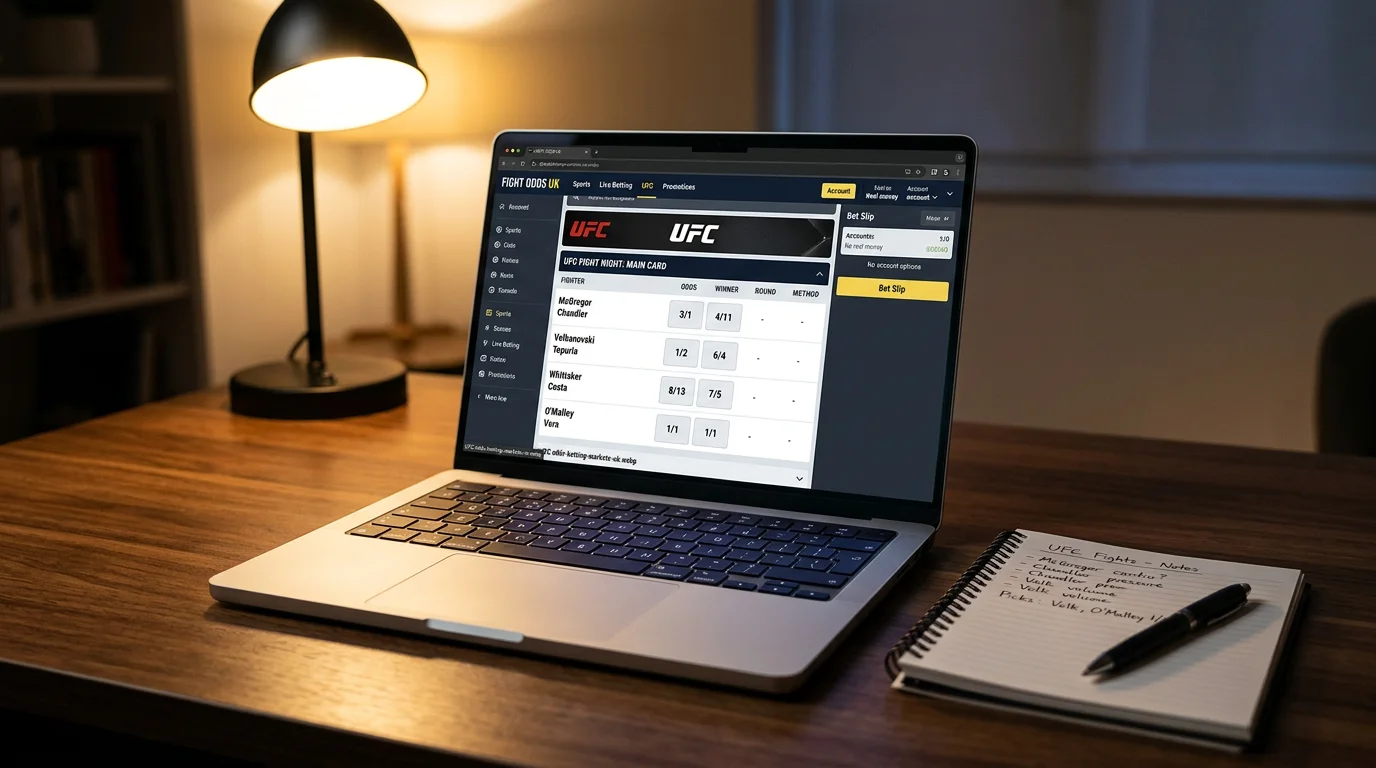
Fractional, Decimal, and Moneyline — Reading UFC Odds
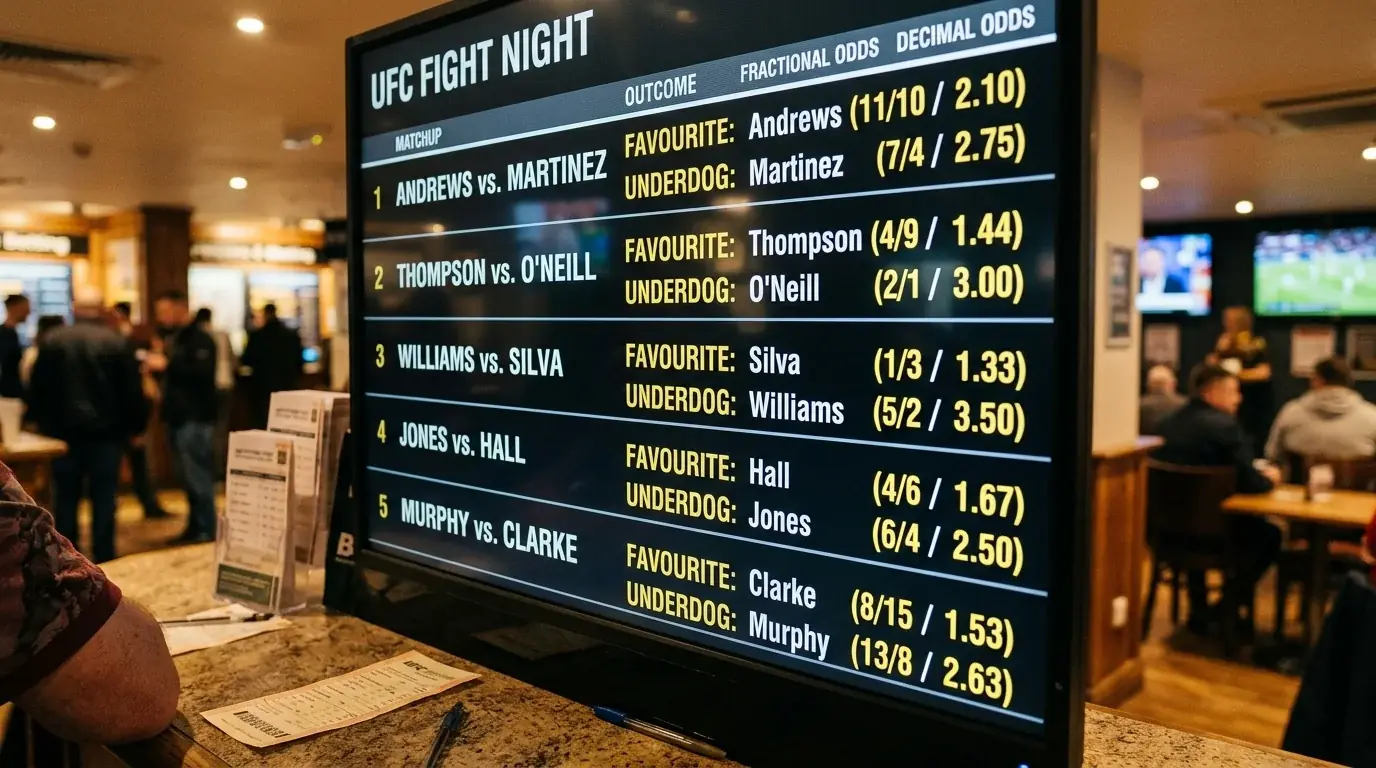
UK bookmakers default to fractional odds, the format you’ll see on most high-street betting shop screens and legacy platforms. A fighter listed at 3/1 pays three pounds profit for every one pound staked, plus your original stake back. A 1/4 favourite returns 25p profit per pound. The number on the left is your potential profit; the number on the right is the unit you risk.
Fractional odds — the traditional UK format expressed as a ratio (e.g. 5/2), where the first number represents potential profit relative to the second number as stake.
Decimal odds — standard across European platforms and increasingly common on UK sites — express total return per unit staked. A fighter at 4.00 returns four pounds total on a one-pound bet (three pounds profit plus your stake). Decimal format makes comparison between fighters faster because the number directly represents the multiplier on your money. If you see 1.25, you know immediately that a one-pound bet returns £1.25 total.
Moneyline odds originate from the American market and dominate MMA coverage globally, which creates an odd situation for UK bettors: most UFC analysis and previews use a format that isn’t native to our betting platforms. Positive moneyline numbers (+300) tell you how much profit a $100 stake would return. Negative numbers (-250) tell you how much you need to stake to profit $100. For UK purposes, conversion to fractional or decimal is usually the smartest move.
Converting between formats — same fighter, same probability
Fractional: 3/1
Decimal: 3/1 = 3.0 + 1.0 = 4.00
Moneyline: +300 (profit of $300 on a $100 stake = 3/1)
Implied probability: 1 / 4.00 = 0.25 = 25%
All four representations describe a fighter the bookmaker prices at a 25% chance of winning.
The critical skill isn’t memorising conversion formulas — any odds calculator handles that. The critical skill is training yourself to see past the format and think in probabilities. Every set of odds is a statement about how likely the bookmaker thinks an outcome is. When you disagree with that probability based on your own analysis, you’ve found a potential bet. When you agree, you move on.
Implied probability — the win percentage embedded in a set of odds. Calculated as 1 divided by the decimal odds. A fighter at 2.00 decimal carries an implied probability of 50%.
Moneyline, Method of Victory, Round Betting, and Props
The moneyline is the simplest UFC market: pick the winner. No conditions, no specifics — just which fighter gets their hand raised. For a new bettor, this is where to start. For an experienced one, moneyline bets remain the backbone of any staking plan because the outcome is binary and the analysis is cleanest.
Moneyline
Pick the winner. Binary outcome. The foundation of most UFC betting strategies and the market where line movement is most informative.
Method of Victory
Predict how the fight ends: KO/TKO, submission, or decision. Divisional data is your edge here — heavyweight KO rates are radically different from strawweight patterns.
Round Betting and Totals
Over/under on total rounds, or exact round of finish. Requires understanding of fight pace, cardio profiles, and divisional finish timelines.
Props and Bet Builders
Fighter-specific and fight-specific propositions: total knockdowns, significant strikes, goes-the-distance. UK platforms increasingly offer bet builders combining multiple props into one wager.
Method of victory is where divisional knowledge starts to pay off. The overall UFC finish rate sits at 53%, but that number hides massive variation across weight classes. Betting “KO/TKO” in the heavyweight division — where roughly half of all fights end in a knockout — is a fundamentally different proposition from betting “KO/TKO” in women’s strawweight, where decisions account for 66.9% of outcomes. The bookmaker’s price reflects an average. Your analysis should reflect the specific division.
Round betting and totals require similar precision. An over/under of 2.5 rounds means the fight needs to reach the halfway point of the third round for the over to cash. In a heavyweight bout, the under has historical backing. In a lightweight contest where 48% of fights go the distance, the over becomes more attractive. Props — knockdowns landed, significant strikes thrown, fight of the night — are where bookmakers have the least historical data to rely on, which means their pricing models are weakest. That’s a feature, not a bug, for bettors willing to do the work.
Core Betting Strategies That Survive the Data
A couple of years ago I ran an experiment. I took every piece of generic UFC betting advice I could find online — “always research your fighters,” “don’t bet with your heart,” “look for underdogs” — and tracked what would have happened if someone followed each tip literally across a full calendar year of UFC events. The result was sobering. Most of the advice was either too vague to act on or actively misleading when applied without context. “Look for underdogs” is great until you realise it doesn’t tell you which underdogs, in which divisions, or at what price range.
Strategies that actually survive contact with data share three characteristics: they’re specific enough to generate testable predictions, they account for the structural features of MMA that differ from other sports, and they respect the fact that over half of all UFC fights end in a finish. That finish rate — KO/TKO at 33.3%, submissions at 19.7%, with only 47% reaching the judges — is what separates MMA betting from football, tennis, or basketball. In those sports, upsets happen gradually. In the octagon, a single punch, a single submission attempt, can invalidate twenty minutes of dominant performance in under five seconds.
The editorial team at Betting.co.uk put it well: styles make fights, and it’s important to ask whether a striker has proven takedown defence against a relentless grappler. That question — about matchup specifics rather than generic fighter quality — is the foundation of any viable UFC betting strategy. For a deeper breakdown of data-backed UFC betting methods, I’ve built an entire analysis around expected value frameworks and staking models. Here, I’ll cover the essential principles.

Do
- Calculate implied probability before assessing any bet — know what the bookmaker is pricing before you decide whether they’re wrong.
- Use division-specific data rather than overall UFC averages — a heavyweight finish rate of 50% means something entirely different from lightweight’s 52%.
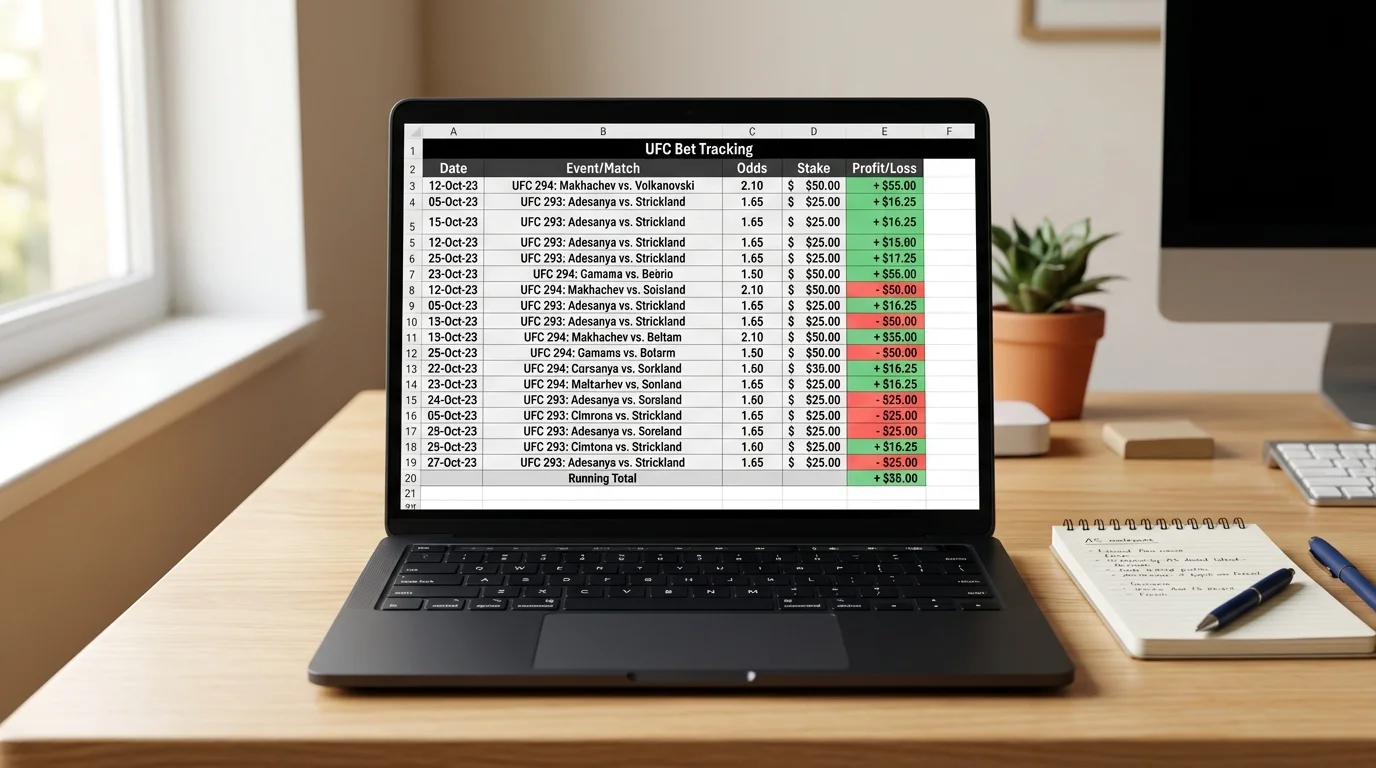
- Track every bet you place with stake, odds, market type, and outcome — you can’t improve a process you don’t measure.
- Focus on one or two weight classes deeply rather than spreading analysis thin across every division.
Don’t
- Build parlays from heavy favourites — the combined implied probability almost always overstates the likelihood of a clean sweep.
- Chase losses after a card goes sideways — MMA volatility means bad nights happen to everyone, including sharps.
- Treat a fighter’s last performance as more predictive than their five-fight body of work.
- Ignore the fight’s context: short-notice replacements, weight misses, and camp changes all shift probabilities.
In UFC’s heavyweight division, approximately 50% of all bouts end via KO/TKO — the highest rate of any weight class. Only 28.6% of heavyweight fights reach the judges’ scorecards.
Finding Value: Implied Probability vs Actual Probability
Value is the only reason to place a bet. Not excitement, not loyalty to a fighter, not a hunch. If the bookmaker prices a fighter at 2.50 decimal (implied probability: 40%) and your analysis says that fighter wins 50% of the time in this matchup, you have a positive expected value bet. If the bookmaker’s price is fair or overstates the fighter’s chances, you pass. Every single bet decision reduces to this comparison.
Value calculation — a practical example
A fighter is priced at 3.00 decimal (fractional: 2/1). The bookmaker’s implied probability: 1 / 3.00 = 33.3%.
Your analysis — based on divisional finish rates, striking differential, and matchup data — estimates this fighter’s true win probability at 40%.
Expected value per pound staked: (0.40 x £2.00 profit) — (0.60 x £1.00 loss) = £0.80 – £0.60 = +£0.20.
That’s a positive expected value of 20p per pound. Over hundreds of bets, this edge compounds. On any single bet, you might still lose.
The tricky part isn’t the maths — it’s estimating true probability. Nobody has a crystal ball, and anyone telling you they’ve calculated a fighter’s exact win percentage to two decimal places is lying. What you can do is build a rough probability range from concrete data: divisional base rates, specific matchup history (striker vs grappler, pressure fighter vs counter-striker), recent form weighted against career averages, and camp/preparation factors. When your range is comfortably above the bookmaker’s implied probability, you have value. When it overlaps or sits below, you walk away.
Most UFC bettors skip this step entirely. They see a fighter they believe will win and back them at whatever price is offered. That’s not betting — that’s prediction without profit motive. The question is never just “will this fighter win?” It’s “will this fighter win often enough at this price to make this bet worth placing repeatedly?” The distinction sounds academic. Over a year of UFC events, it’s the difference between a growing bankroll and a shrinking one.
Divisional Finish Rates — Where the Edge Hides
The single most underused dataset in UFC betting is divisional finish rates. I can’t count how many times I’ve seen a tipster recommend “under 2.5 rounds” without specifying the weight class, as if a lightweight fight and a heavyweight fight operate on the same clock. They don’t. Not even close.
Heavyweight
~50% KO/TKO rate. Only 28.6% reach a decision.
Lightweight
29.1% KO/TKO. 48% go to the judges.
Women’s strawweight
66.9% decision rate. Among finishes, 59% are submissions.
These aren’t minor differences — they’re structural. Heavyweight fighters carry more power and less cardio, which means fights end earlier and more violently. Lightweights are more technically refined, better conditioned, and harder to finish, which pushes outcomes toward the scorecards. Women’s divisions show a completely different pattern: when finishes do occur, submissions dominate at 59%, not knockouts. Betting “KO/TKO” in a women’s flyweight bout is a fundamentally different proposition from the same bet in men’s heavyweight.
| Division | KO/TKO rate | Submission rate | Decision rate | Betting implication |
|---|---|---|---|---|
| Heavyweight | ~50% | ~21% | ~28.6% | Under rounds and KO/TKO method bets have strong base rates |
| Lightweight | 29.1% | ~23% | 48% | Decision and over rounds bets carry higher hit rates |
| Women’s strawweight | Low | Moderate | 66.9% | Over rounds and decision bets are structurally favoured |
The edge comes from mapping these base rates against the bookmaker’s price. If a heavyweight bout is priced at over/under 1.5 rounds with the over at 1.80, you know that historically only about half of heavyweight fights even reach a second round. The bookmaker is essentially offering you close to even money on a coin-flip outcome — but the specific matchup might push that probability well above or below 50%. A power striker against a chinny opponent in the heavyweight division? That’s where the under has real support. Two durable grapplers with strong chins? The over becomes the play, even in a division known for early finishes.
Fighter Data That Predicts Outcomes
Every UFC preview you’ll ever read will tell you to “study the stats.” Few of them specify which stats, why they matter, or how to weigh them against each other when they point in conflicting directions. I spent the better part of two years logging which metrics correlated with bet outcomes and which were noise. The results surprised me — some of the numbers casual fans obsess over turned out to be poor predictors, while a handful of overlooked metrics carried real signal.
As established earlier, more than half of UFC bouts end before the scorecards — but that baseline tells you nothing about a specific matchup. What matters is how individual fighter metrics interact within a pairing. Significant strikes landed per minute, striking accuracy, takedown accuracy, takedown defence percentage, and average control time — these five metrics, when compared head-to-head between two opponents, give you the structural outline of how a fight is likely to play out.
Significant strikes per minute (SLpM) measures a fighter’s offensive output on the feet. But high SLpM in isolation can be misleading — a fighter who throws 7.5 significant strikes per minute but absorbs 6.8 is engaged in wars, not dominating. The differential between strikes landed and strikes absorbed tells a more complete story than either number alone.
Significant strikes — UFC’s official metric for meaningful strikes at distance or in the clinch, excluding ground-and-pound unless landing with clear impact. The standard output metric is significant strikes landed per minute (SLpM).
Takedown accuracy and takedown defence are the grappling equivalents. A wrestler who converts 55% of takedown attempts against a striker who defends only 50% of attempts has a clear path to controlling the fight on the ground. But context matters enormously: those percentages are career averages that include fights against opponents of vastly different skill levels. A fighter’s takedown defence percentage might look strong at 72%, but if that number was compiled primarily against strikers who rarely shoot, it tells you nothing about how they’ll handle a Division I wrestler.
Kyle Marley, an MMA expert at SportsLine, demonstrates the kind of matchup-specific thinking that separates good analysis from stat-sheet reading. When breaking down a recent bout, he noted that one fighter should be the better striker at range while his opponent should hold the wrestling and grappling edge — and crucially, predicted that the grappler would land takedowns in the matchup. That kind of directional assessment, grounded in how specific skillsets interact, is what fighter data analysis should produce. For a full breakdown of which metrics carry the most predictive weight, see the UFC fighter stats guide for betting.
Striker vs Grappler: How Style Matchups Shift the Line
Striker vs Grappler Value Calculator
The public loads onto the flashy striker; the grinding grappler’s price drifts longer than it should. Enter the takedown numbers and the market prices, and the model estimates how far the grappler’s true chance sits above the line.
How this works: the two market prices convert to implied probabilities and are de-vigged to a no-vig baseline (each side ÷ their sum). The control edge is the grappler’s takedown accuracy minus the striker’s exposure (100% − takedown defence) – how often the grappler is likely to convert a takedown the striker can’t stop. A positive edge shifts the grappler’s chance above the market’s no-vig baseline, scaled so a large grappling gap moves the number more, and weighted up for a 3-round fight (where the grappler doesn’t have to sustain the pace for 25 minutes) and down for a 5-rounder. Value = (adjusted probability × the grappler's decimal odds) − 1 per £1. The reason this market pays: bookmakers and the public overweight recent striking highlights and underweight grinding control, so the grappler’s price on prelim and Fight Night cards drifts longer than the takedown numbers justify. The model is a directional guide, not a projection engine – takedown percentages are career averages compiled against uneven opposition, so weight them against who the numbers were built on, the striker’s chin and get-up ability, and whether the grappler can actually close the distance. Not a tip. Not financial advice. 18+ – GamStop and BeGambleAware are protection routes; National Gambling Helpline 0808 8020 133.
The oldest question in MMA — striker versus grappler — is also the most consequential for betting. Not because the answer is simple, but because bookmakers and the betting public consistently overvalue recent striking highlights and undervalue grinding grappling dominance. I’ve tracked this bias across multiple cards: a flashy knockout artist will almost always attract more public money than a control-heavy wrestler, which means the wrestler’s odds are often longer than they should be.
Hypothetical matchup — striker vs grappler
Fighter A (striker): 1.55 decimal / 11/20 fractional. Implied probability: 64.5%.
Fighter B (grappler): 2.50 decimal / 6/4 fractional. Implied probability: 40.0%.
Combined implied probability: 104.5% (the 4.5% overround is the bookmaker’s margin).
If Fighter B’s takedown accuracy is above 45% and Fighter A’s takedown defence is below 60%, the true probability of a Fighter B victory may sit closer to 48-50%. At 2.50 decimal, that’s a value bet.
The key data points in a striker-vs-grappler matchup are straightforward. On the grappler’s side: takedown accuracy, average takedowns per 15 minutes, and submission attempts per 15 minutes. On the striker’s side: takedown defence percentage, time spent on the ground versus on the feet, and ability to get back to standing after being taken down (measured indirectly through control time absorbed). When the grappler’s offensive numbers are strong and the striker’s defensive numbers are weak, the line almost always underestimates the grappler’s chances — particularly if the fight is scheduled for three rounds, where the grappler doesn’t need to sustain a high pace for 25 minutes.
This doesn’t mean grapplers are always undervalued. In high-profile main events, where the betting public has had weeks to process matchup data, the line tends to be sharper. It’s on Fight Night cards and prelim bouts — where less money flows and less analysis circulates — that the striker-vs-grappler pricing inefficiency persists. Those are the fights I prioritise when building a card-by-card betting plan.
UFC Betting in the UK: Regulation, Tax, and Market Reality
In April 2026, the UK gambling landscape shifted in a way that most MMA bettors still haven’t fully processed. Remote Gaming Duty — the tax that online gambling operators pay on their UK revenue — jumped from 21% to 40%. That’s not a tweak. That’s nearly doubling the tax burden on every online casino, poker room, and sports betting platform serving British punters. And a further increase to 25% on remote sports betting duty follows in April 2027.
Why should a UFC bettor care about operator taxes? Because the Office for Budget Responsibility estimated that operators will seek to pass through around 90% of those duty increases by raising prices or reducing payouts. “Raising prices” in betting terms means tighter odds. “Reducing payouts” means lower returns on winning bets. The government expects to collect an additional £1.1 billion in gambling taxes by 2029-30, and the people funding that increase are, overwhelmingly, the punters themselves.
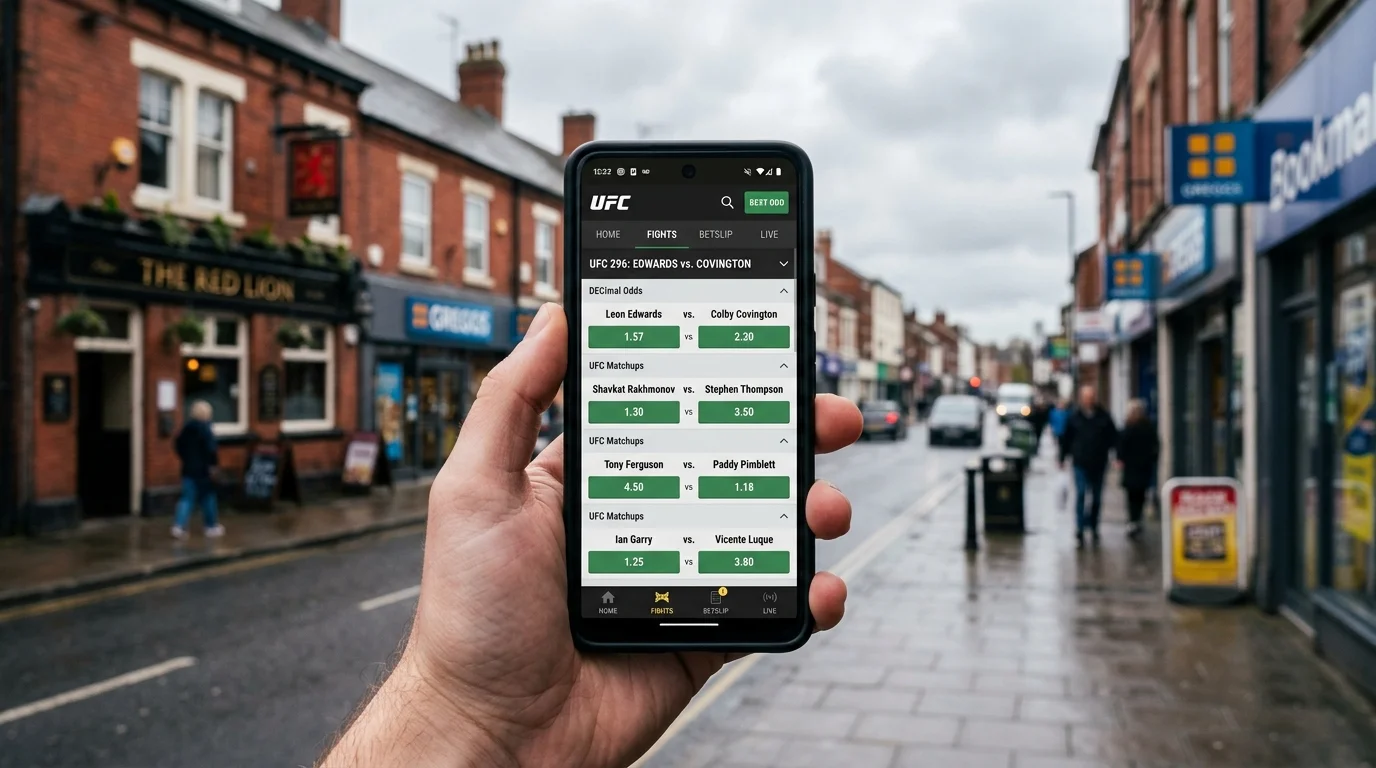
The 2026 Remote Gaming Duty increase from 21% to 40% is the largest single tax rise in UK online gambling history. For UFC bettors, this translates directly to tighter odds and smaller margins for finding value. Comparing odds across multiple UKGC-licensed operators is now more important than ever.
The UK market itself is substantial. Ten percent of the adult population participates in online sports betting, and roughly 47% engage with some form of gambling. The gender split in sports betting is stark — 15% of men versus 4% of women — though UFC’s global fan base bucks the trend somewhat, with 40% of fans being female. Around 290 million online bets on real events are placed monthly across the UK, with football generating the lion’s share at £1.1 billion in gross gaming yield. MMA’s share is smaller but growing fast, mirroring the $10.3 billion global handle.
The UK has 5,825 licensed bookmaker premises as of early 2025, a decline of 1.8% year-on-year. The shift to online betting continues to accelerate, with the remote sector now generating £7.8 billion in annual gross gaming yield.
For UK-based bettors, the practical implications are threefold. First, always compare odds across at least three UKGC-licensed platforms before placing any UFC bet — the margin differences between operators have widened as each absorbs the tax increase differently. Second, understand that enhanced odds promotions and free bet offers may become less generous as operators tighten their marketing budgets. Third, treat the regulatory environment as a data point in your betting strategy: the operators that survive the tax squeeze will likely be the larger, more diversified platforms — meaning the competitive landscape for MMA-specific markets may narrow. For a detailed comparison of what different UK platforms offer MMA bettors, see the UFC betting sites UK guide.
Bankroll Management for MMA Bettors
I blew through my first MMA bankroll in six weeks. Not because my picks were terrible — I was hitting at a reasonable rate — but because I had no system for sizing bets relative to my total fund. A good run made me overconfident, I pushed stakes up on a stacked card, and when three favourites lost in one night, the damage was disproportionate. It’s the most common story in sports betting, and in MMA it happens faster because the volatility is higher than almost any other sport.
The standard advice is to stake 1-2% of your bankroll per bet. That’s a fine starting point, but it needs adjustment for MMA specifically. In football, where draw results and low-scoring games create a more predictable distribution of outcomes, 2% stakes give you ample runway to absorb losing streaks. In UFC, where a single illegal knee, a freak injury, or a flash knockout can upend any prediction, 1% is the safer default. I use 1% for standard plays, scale up to 1.5% when my confidence in a value assessment is high, and never exceed 2% under any circumstances. The 18-24 age demographic — the only group where betting “because it’s fun” outranks the profit motive — is especially prone to ignoring these limits.
Before every UFC bet
- Calculated implied probability from the odds
- Estimated true probability from matchup data
- Confirmed positive expected value (true probability > implied probability)
- Checked stake size: within 1-2% of current bankroll
- Reviewed bankroll status: no chasing from prior losses
- Recorded the bet in tracking log with full details
Unit sizing in practice
Starting bankroll: £500.
Standard unit (1%): £5 per bet.
High-confidence unit (1.5%): £7.50 per bet.
Maximum unit (2%): £10 per bet.
After a losing week that drops the bankroll to £450, recalculate: standard unit becomes £4.50. The unit shrinks as the bankroll shrinks — this is how you survive variance without going bust.
A bankroll is not a deposit. It’s a dedicated fund that you’ve decided, in advance, represents the total amount you’re willing to risk on UFC betting. Treat it like a business account: money goes in at the start, profits get withdrawn periodically, and the operating capital is never topped up from personal funds on impulse. If the bankroll hits zero, stop. Reassess your strategy, review your tracking data, and only reload if you’ve identified specific changes to make. The goal isn’t to bet forever — it’s to bet profitably, and that requires treating capital as finite.
Live UFC Betting: Opportunities and Traps
The first time I placed a live UFC bet, I was reacting to a knockdown in the first round. The fighter I’d backed pre-fight got dropped, the live odds on his opponent cratered to 1.15, and in a moment of panic I hedged with a live bet on the other side. The original pick recovered, won by decision in the third round, and I’d wasted money on a hedge born from emotion rather than analysis. That experience taught me that live betting amplifies both opportunity and impulsiveness — and you need a plan before the fight starts, not during it.
Live betting — also called in-play betting — now accounts for a massive share of online wagering revenue. In-play bets generated 62.35% of online betting revenue in 2025, growing at a rate of 13.62% per year through 2031. For UFC, the in-play market is smaller but fiercer than football or tennis because fights are shorter, outcomes swing harder, and the window for placing a bet between rounds is narrow. A three-round fight gives you two inter-round breaks of approximately 60 seconds each. That’s your decision window.
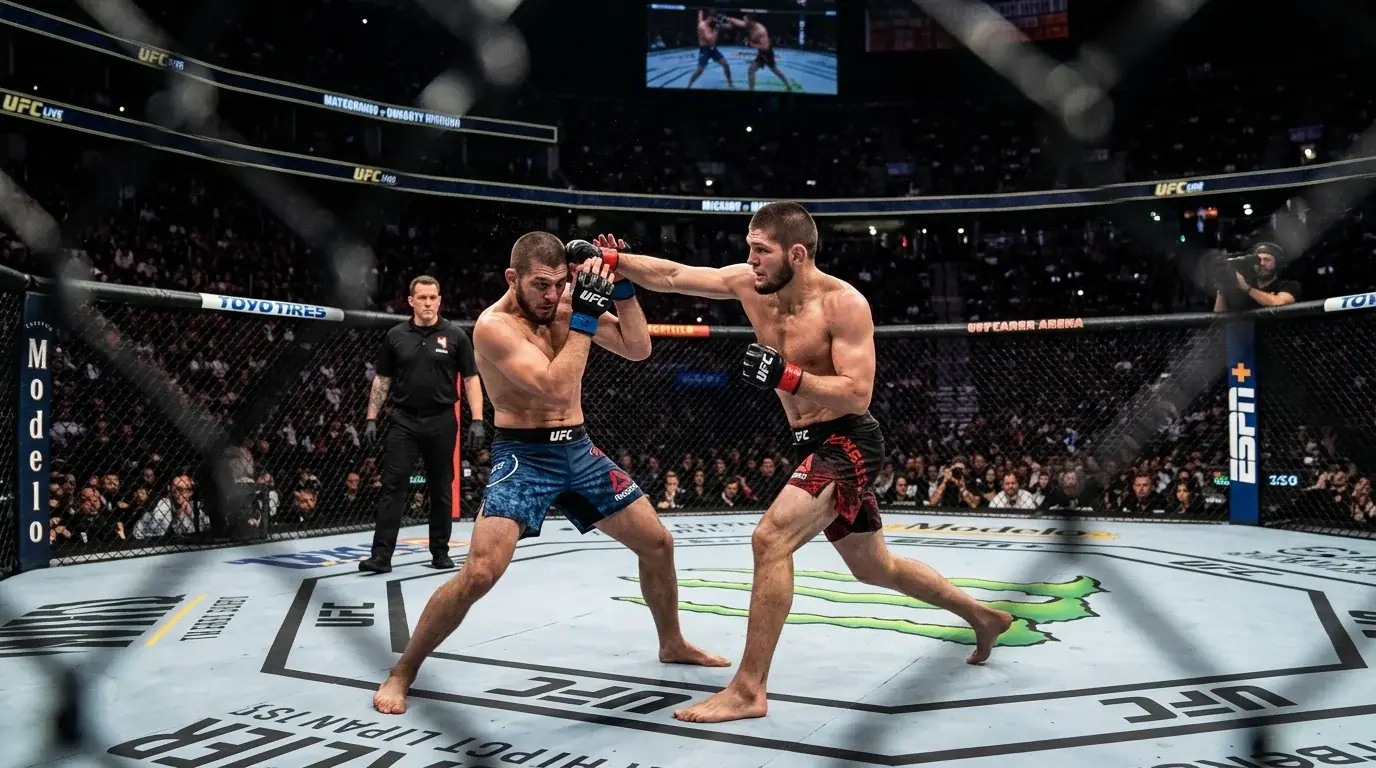
MMA live odds are among the most volatile in sports betting. A single takedown, a significant strike that opens a cut, or a visible shift in a fighter’s energy between rounds can move the line by 30-50% in seconds. This volatility creates genuine value for bettors who prepare scenarios in advance — and genuine risk for those reacting emotionally to what they just watched.
The editorial team at DRatings.com makes an honest point that applies doubly to live betting: analytics always work best when there is more matches and data to analyse, so some caution should be used with projections. In-play, you’re projecting forward from one or two rounds of information. That’s a tiny sample. A fighter who lost the first round on the scorecards might still be implementing a game plan that favours later rounds — slow starters exist, and they’re often mispriced live because the public overweights what just happened.
Effective live UFC betting requires pre-fight preparation, not in-the-moment reaction. Before any fight you’re considering for in-play wagers, identify two or three scenarios — “if Fighter A loses round one,” “if the fight goes to the ground early,” “if neither fighter is hurt through two rounds” — and pre-determine what action, if any, each scenario triggers. Without this framework, live betting becomes gambling on adrenaline.
The practical approach: designate a small portion of your card-night bankroll — no more than 20-25% — for live bets. The rest stays on pre-fight positions. This structure forces discipline. It means you’re not emptying your bankroll into the in-play market after a few exciting exchanges. For a full tactical breakdown of round-by-round strategy and platform-specific considerations for UK punters, the live UFC betting guide covers what this section can only introduce.
Integrity and Suspicious Betting Activity in UFC
In November 2025, something happened that every UFC bettor should know about. Isaac Dulgarian, a fighter on the active roster, was pulled from a card and subsequently fired after IC360 — UFC’s integrity monitoring partner — flagged anomalous betting activity on his bout. Both Caesars and DraftKings voided and refunded all wagers on the fight. It wasn’t a rumour or a conspiracy theory. It was a real-time intervention that demonstrated both the vulnerability and the evolving safeguards of the UFC betting market.
Dana White’s response was characteristically blunt. He described calling Dulgarian before the fight and asking directly whether he was injured, whether he owed anyone money, whether anyone had approached him. White made clear that anyone who tries to cheat will face the organisation as their worst enemy, and that UFC would immediately involve the FBI in any investigation. Whatever your opinion of White’s management style, the message to the roster was unambiguous.
The Dulgarian case was the most visible integrity intervention in UFC history, but it wasn’t an isolated signal. Unconfirmed reports suggest the FBI flagged more than 100 UFC fights in 2025 alone for anomalous betting patterns. Whether those flags represent actual corruption, coincidental market movements, or overly sensitive detection algorithms remains an open question — but the volume demands attention from anyone placing money on these events.
UFC’s integrity infrastructure has expanded rapidly. In 2023, the organisation partnered with ProhiBet, a betting activity monitoring firm. By 2024-2025, IC360 had been appointed as the official integrity partner, monitoring every UFC event for irregular betting patterns across licensed operators worldwide. The system works by comparing expected betting volume and price movement against actual market data in real time. When the deviation exceeds a threshold, it triggers an alert.
For bettors, the integrity question connects directly to a structural issue: fighter compensation. UFC fighters receive approximately 15-18% of the organisation’s total revenue — roughly $255 million out of $1.502 billion in 2025. Compare that to NBA, NFL, and NHL athletes who receive 48-50% of league revenue. The gap is enormous, and while it doesn’t excuse or predict corruption, it creates a financial environment where low-card fighters earning modest sums face different incentive structures than athletes in team sports. The $335 million antitrust settlement in 2024 acknowledged aspects of this imbalance, but the underlying revenue split hasn’t fundamentally changed.
None of this means UFC betting is unsafe. It means bettors should treat integrity as a variable, not a given. Watch for late line movements that don’t correspond to public information. Be cautious about heavy action on prelim-card fights involving fighters with small public profiles. And understand that the monitoring systems — while significantly better than what existed five years ago — are reactive by design. They catch anomalies after they emerge, not before.
The Paramount Era: How UFC’s New Deal Changes Betting
When UFC signed a seven-year, $7.7 billion contract with Paramount in August 2025, the pay-per-view model that had defined MMA fandom for two decades effectively ended. Fights that once sat behind a $79.99 paywall moved to a subscription platform. The implications for betting were immediate and structural, not cosmetic.
UFC 229 — Khabib versus McGregor in 2018 — sold 2.4 million PPV buys, the all-time record. UFC 300 managed 1.2 million, the highest number without McGregor on the card. Under the Paramount deal, those PPV gates no longer exist. Every fight is accessible to every subscriber.

The first direct evidence arrived in March 2026 when UFC 326 debuted on CBS. The broadcast drew an average audience of 2.47 million viewers — the largest UFC audience on linear television since 2016. That’s not just a viewership milestone. It’s a betting market shift. More eyeballs on a fight card means more casual bettors entering the market, which means more public money flowing through the odds, which means the line is shaped more by casual sentiment and less by sharp analysis. For informed bettors, an influx of casual money is an opportunity. It softens lines, creates overreactions to name recognition, and increases the gap between implied probability and true probability on fights where the less well-known fighter holds a genuine edge.
The Paramount deal also changed the rhythm of UFC’s event calendar. Without PPV revenue pressure, the organisation can distribute high-profile fights more evenly across cards rather than stacking numbered events at the expense of Fight Nights. For bettors, this means the quality gap between “big” and “small” cards is narrowing. Fights that would have been buried on an ESPN prelim in 2024 now carry real stakes and real viewership — which translates to deeper betting markets with more liquidity.
UFC Freedom 250 — scheduled for the White House lawn in June 2026 — represents the apex of the Paramount era’s ambition. An event of that profile, in that setting, will attract the kind of public betting volume that distorts lines across every fight on the card. The bettors who’ve done the matchup work in advance, before the hype cycle takes over, will have a window to grab value before the casual money floods in.
With the market context, strategy frameworks, and data points covered above, let’s address the questions UK punters ask most often.
UFC Betting Tips FAQ
How do UFC betting odds work?
UFC odds represent the bookmaker’s assessment of each fighter’s probability of winning. In the UK, you’ll most commonly see fractional odds (e.g. 3/1) or decimal odds (e.g. 4.00). Both formats express the same underlying probability — they just present the numbers differently. Fractional odds show profit relative to stake: 3/1 means three pounds profit for every one pound risked. Decimal odds show total return per unit staked: 4.00 means four pounds back on a one-pound bet, including the original stake. The implied probability is calculated by dividing 1 by the decimal odds. At 4.00, the implied probability is 25%. Bookmakers build a margin (the overround) into the odds for both fighters, so the combined implied probabilities always exceed 100%.
What is the best strategy for betting on UFC fights?
The most sustainable strategy is value betting — identifying fights where the bookmaker’s implied probability is lower than your estimated true probability of an outcome. This requires calculating implied probability from the odds, estimating true probability from matchup-specific data (divisional finish rates, striking differentials, grappling metrics), and only placing a bet when the gap between the two is meaningful. Combine this with strict bankroll management — staking 1-2% of your total fund per bet — and disciplined bet tracking to identify what’s working and what isn’t over time. Specialising in one or two weight classes, rather than spreading analysis across the entire roster, gives you a deeper dataset and a sharper edge.
Can you bet on UFC fights in the UK?
UFC betting is fully legal in the UK through any bookmaker licensed by the UK Gambling Commission (UKGC). All licensed operators must adhere to strict regulatory standards including age verification, responsible gambling tools, and financial safeguards for customer funds. You need to be at least 18 years old and will be required to complete identity verification (KYC) before placing bets. Most major UK platforms offer a range of UFC markets including moneyline, method of victory, round betting, and props. The regulatory environment is tightening — Remote Gaming Duty rose to 40% in April 2026 — but the legality of UFC betting itself is firmly established.
What are the most popular UFC betting markets?
The moneyline — picking the fight winner — is the most popular market and accounts for the majority of UFC betting volume. Method of victory (KO/TKO, submission, or decision) is the second most popular, particularly among bettors who analyse divisional finish rates. Over/under rounds allows you to bet on fight length, typically set at 1.5 or 2.5 rounds. Proposition bets (props) cover fighter-specific outcomes like knockdowns landed or significant strikes thrown. Bet builders, which combine multiple props and outcomes into a single wager, are gaining popularity on UK platforms. Parlays or accumulators — combining moneyline picks across multiple fights — attract significant volume but carry higher risk due to the multiplicative effect of MMA’s volatility.
How do you find value in UFC betting?
Value exists when the bookmaker’s implied probability understates a fighter’s true chance of winning. Start by converting the odds to implied probability (1 divided by decimal odds). Then build your own probability estimate from concrete data: divisional base rates for finishes versus decisions, head-to-head style matchup analysis (striker vs grappler dynamics), recent form weighted against career averages, and contextual factors like camp changes, short-notice replacements, or weight cut history. When your estimated probability is meaningfully higher than the bookmaker’s implied probability, you have a potential value bet. The key word is “meaningfully” — small edges get erased by the bookmaker’s margin.
Is live betting available for UFC events?
Most UKGC-licensed bookmakers offer in-play betting on UFC events, with odds updating between rounds and sometimes during rounds. Live MMA odds are among the most volatile in sports betting — a single knockdown or takedown can move the line by 30-50% instantly. Effective live betting requires pre-fight scenario planning rather than in-the-moment reactions. The inter-round window is roughly 60 seconds, which leaves minimal time for analysis. In-play bets accounted for over 62% of online betting revenue in 2025, reflecting the market’s rapid growth, but the speed and volatility of UFC live betting make it more suitable for experienced bettors with pre-established decision frameworks.
How does fighter style matchup affect UFC betting?
Style matchup is one of the strongest predictors of UFC fight outcomes and directly impacts how bookmakers set their lines. A striker facing a grappler produces a fundamentally different fight from two strikers or two wrestlers meeting. Key metrics to evaluate include the grappler’s takedown accuracy versus the striker’s takedown defence, the striker’s knockout power versus the grappler’s ability to absorb damage, and whether the fight is scheduled for three or five rounds (grapplers often benefit from shorter fights where cardio is less of a factor). Bookmakers and the betting public tend to overvalue recent striking highlights and undervalue grinding grappling control, which creates recurring pricing inefficiencies — particularly on prelim and Fight Night cards where less public analysis is available.
Created by the ”ufc Betting Tips” editorial team.