UFC Odds Explained: How to Read and Use MMA Betting Lines
 Available in US
Table of Contents

What UFC Odds Actually Tell You — and What They Hide
I spent my first two years betting on UFC fights thinking I understood odds. I did not. I could read the numbers, sure — favourite here, underdog there — but I had no idea what those numbers were actually encoding, or more importantly, what they were quietly concealing. That gap between reading odds and understanding them cost me real money before I figured out the difference.
Here is what most newcomers miss: UFC odds are not predictions. They are prices. A bookmaker is not telling you who will win a fight — they are telling you how much they will charge you to bet on each outcome. That distinction matters enormously, because the price already includes the bookmaker’s profit margin, the weight of public money, and a set of assumptions about a fight that may or may not reflect reality. The MMA betting market handled $10.3 billion in 2024, growing 17% year on year, which means more money is flowing into these prices than ever before — and more opportunity exists for punters who can decode what those prices actually mean.
The global sports betting market sits at roughly $125 billion in 2026 and is projected to reach $325.71 billion by 2035. MMA occupies a growing slice of that pie, and UFC drives almost all of it. Yet the way UFC odds are set, displayed, and moved remains opaque to most bettors. Bookmakers benefit from that opacity. You do not.
This guide breaks down the three odds formats you will encounter on UK platforms, shows you how to convert any of them into implied probability, explains how bookmakers engineer their margin into every price, and walks through why those prices shift — sometimes dramatically — between the moment a fight is announced and the second the cage door closes. I have been analysing MMA betting lines for nine years, and the mechanics I cover here form the foundation of every profitable approach I have used or seen used. If you get this wrong, nothing else in your betting process will save you.
None of this is abstract theory. Every concept comes with a worked calculation you can apply to the next UFC card you open on your betting app. By the end, you will read a fight’s odds the way a market analyst reads a balance sheet — not as a simple signal, but as a complex story with gaps worth exploiting.
See also: ufc betting tips for odds formats and market breakdowns.
Three Odds Formats UK Punters Need to Know
Walk into any UK betting shop and the odds are fractional. Open a European exchange and they are decimal. Browse an American MMA forum and every line is moneyline. The same fight, the same probability assessment, expressed three completely different ways. If you only read one format fluently, you are limited to one pool of information — and in MMA betting, information asymmetry is the edge.
I am going to walk through all three formats not because you need to memorise conversion formulas (though I will give them to you), but because understanding each format reveals something different about how the price works. Fractional odds make profit calculation intuitive. Decimal odds make comparison fast. Moneyline odds make favourite-underdog gaps immediately visible. Each format is a lens, and using all three gives you a clearer picture of any fight.
Fractional Odds: The UK Default
Fractional odds are what you grew up with if you have ever watched horse racing on a Saturday afternoon. They express the profit you stand to make relative to your stake. A fighter listed at 3/1 returns three pounds of profit for every one pound you stake, plus your original pound back — four pounds total. A fighter at 1/4 returns twenty-five pence of profit for every pound risked.
The format has a quirk that trips up new MMA bettors. When the number on the left is smaller than the number on the right — 1/3, 2/7, 1/5 — you are looking at a favourite, and the profit relative to your risk is small. When the left number is larger — 5/2, 7/1, 11/4 — you are looking at an underdog with a bigger potential return. The further those two numbers sit apart, the more extreme the price.
To convert fractional odds into implied probability, divide the right-hand number by the sum of both numbers and multiply by 100. For a fighter at 4/1: 1 divided by (4 + 1) = 0.20, or 20% implied probability. For a favourite at 1/3: 3 divided by (1 + 3) = 0.75, or 75% implied probability. I use this calculation dozens of times on every fight card, and after a while it becomes automatic.
The advantage of fractional odds is clarity on profit. If I stake 50 pounds at 7/2, I know instantly that my profit — if the bet wins — is 175 pounds. No further maths needed. The disadvantage is that comparing two fractional prices is harder than it looks. Is 11/8 better or worse than 6/4? You have to convert both to a common denominator or switch to decimal to compare efficiently.
For UFC specifically, fractional odds are still the default display on most UK-licensed platforms, though nearly every site now lets you toggle between formats in your settings. I recommend setting your default to decimal for analytical work and keeping fractional for quick stake-profit calculations.
Decimal Odds: The European Standard
Decimal odds represent the total return per unit staked, including the stake itself. A fighter priced at 3.50 returns three pounds fifty for every pound wagered — that is two pounds fifty profit plus the original pound. A favourite at 1.25 returns one pound twenty-five, meaning twenty-five pence profit on every pound risked.
The beauty of decimal odds is instant comparison. If Fighter A is 2.40 at one bookmaker and 2.55 at another, you know immediately which price is better without any mental gymnastics. This matters when you are scanning multiple sites for the best available line on a UFC main event, which I do for every fight I bet on seriously.
Converting decimal odds to implied probability is the simplest of the three formats: divide 1 by the decimal odds, then multiply by 100. A price of 2.00 implies exactly 50% probability. A price of 1.50 implies 66.7%. A price of 4.00 implies 25%. The lower the decimal number, the stronger the favourite. Anything above 2.00 is an underdog.
One thing I appreciate about decimal format for MMA analysis is that the bookmaker’s margin becomes visible faster. If both fighters in a bout are priced at 1.90 (which implies 52.6% each), the total implied probability is 105.2%. That 5.2% above 100% is the bookmaker’s overround — their built-in profit. In fractional format, spotting that overround requires an extra calculation step.
Moneyline Odds: The MMA Native Format
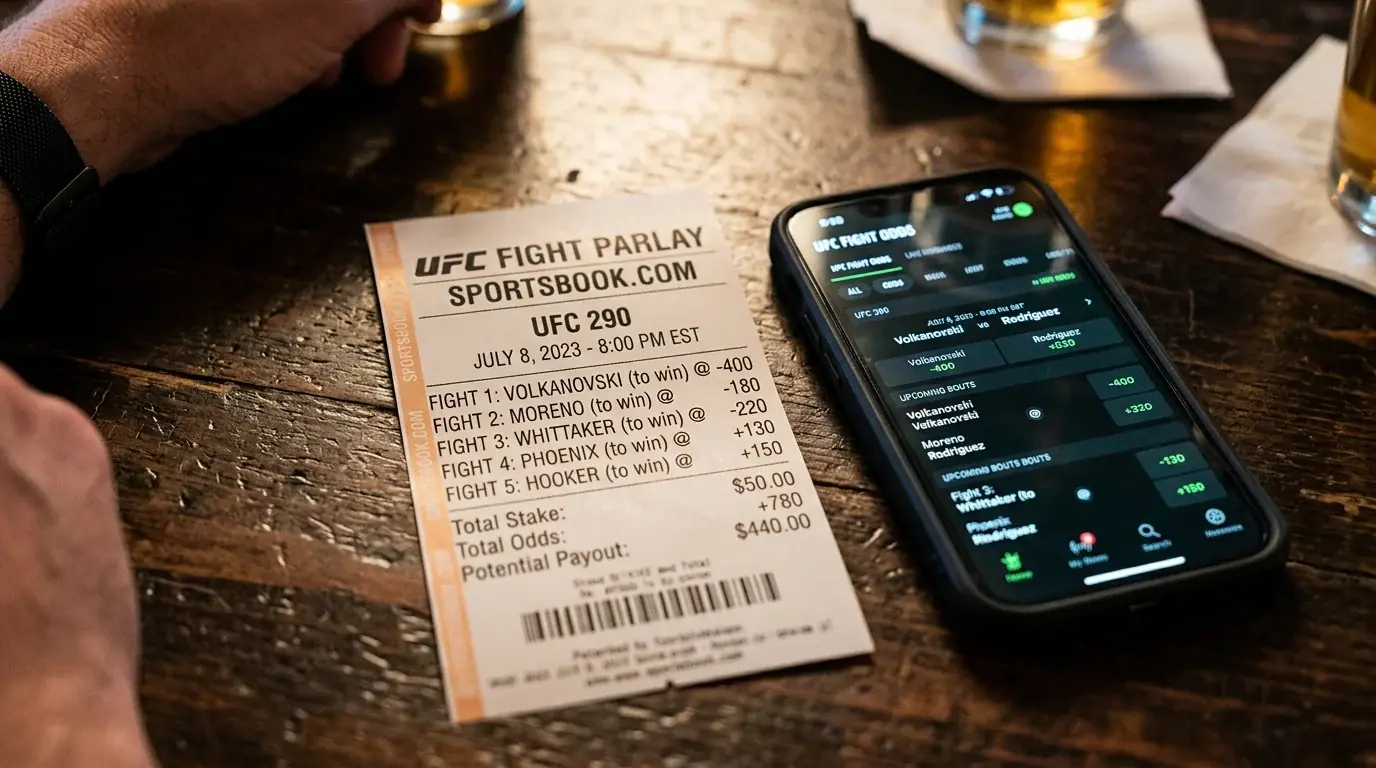
Moneyline odds dominate American sportsbooks and, by extension, most English-language MMA coverage. They use positive and negative numbers to indicate underdogs and favourites. A fighter at +250 is an underdog — stake 100 to win 250 profit. A fighter at -300 is a favourite — stake 300 to win 100 profit.
I call moneyline the “MMA native format” because nearly every UFC odds discussion you will find online — forums, podcasts, expert breakdowns — uses it. If you cannot read moneyline fluently, you are locked out of the largest pool of MMA betting analysis available. That alone is reason enough to learn it.
The conversion to implied probability has two paths. For negative (favourite) lines: divide the absolute value of the line by (the absolute value plus 100), then multiply by 100. A -300 favourite: 300 / (300 + 100) = 75% implied probability. For positive (underdog) lines: divide 100 by (the line plus 100), then multiply by 100. A +250 underdog: 100 / (250 + 100) = 28.6% implied probability.
The practical advantage of moneyline is that the magnitude of the number immediately tells you how lopsided the matchup is priced. A -150 favourite is a modest lean. A -500 favourite is a massive one. That visual clarity helps when you are scanning a full UFC card of 12 or 13 fights and want to spot the competitive matchups quickly — the ones where value is most likely to exist.
For UK punters, moneyline odds are rarely the default display on domestic platforms, but every major site offers them as a toggle. I keep my primary display on decimal for analysis but switch to moneyline when reading American MMA content, which accounts for the majority of expert fight breakdowns available online.
Implied Probability: Converting Odds Into Percentages
A few years back I watched a punter on a forum argue passionately that a UFC heavyweight at 1.40 was a “lock.” When I asked him what implied probability 1.40 represented, he could not answer. He was betting based on gut feel attached to a number he did not actually understand. That is more common than you would think, and it is exactly where the bookmaker’s advantage lives.
Implied probability is the percentage chance of an outcome that the odds encode. It is the single most important concept in this entire guide, because every other analytical tool I use — value identification, margin assessment, line movement analysis — builds on it. Without implied probability, you are flying blind.
Here is a worked example using a real-world scenario. Suppose a lightweight bout is priced with Fighter A at 1.65 (decimal) and Fighter B at 2.40. Converting both:
Fighter A: 1 / 1.65 = 0.606, or 60.6% implied probability.
Fighter B: 1 / 2.40 = 0.417, or 41.7% implied probability.
Add those together: 60.6% + 41.7% = 102.3%. The real probabilities of all outcomes in a two-fighter contest must sum to exactly 100%. That extra 2.3% is the bookmaker’s margin — their overround, the price you pay for the privilege of placing a bet. The UK online betting market generates roughly £7.8 billion in gross gaming yield annually, and every penny of it comes from margins like this one.
To strip out the margin and find the “true” implied probability each fighter carries, divide each individual implied probability by the total. Fighter A’s cleaned probability: 60.6 / 102.3 = 59.2%. Fighter B’s: 41.7 / 102.3 = 40.8%. Those cleaned numbers are closer to what the bookmaker actually believes about the fight, though they still contain modelling assumptions you might disagree with.
Why does this matter for your betting? Because once you have the implied probability, you can compare it against your own assessment. If you believe Fighter B has a 48% chance of winning — maybe you have studied the matchup and see a stylistic edge the market undervalues — then a price implying only 40.8% represents a value bet. The odds are offering you a better price than the fight warrants. That gap is where profit lives over hundreds of bets.
I run this calculation for every fight on every card. It takes about ten seconds per bout once you have the habit. Some weeks I find three or four value discrepancies. Some weeks I find none. Both outcomes are useful, because knowing when value does not exist is just as important as knowing when it does — it stops you from placing bets for the sake of action.
One practical tip: most UK betting platforms now display implied probability alongside the odds if you dig into the settings or use a companion tool. But I prefer calculating it myself, because the act of doing the maths forces me to engage with the number rather than just glancing at it. That small friction has saved me from lazy bets more times than I can count.
How Bookmakers Build Their Margin Into UFC Odds
Every bookmaker is a business, and every business needs revenue. In sports betting, that revenue comes from the margin — the overround baked into every set of odds. Understanding how that margin works in MMA specifically, and where it tends to be larger or smaller, is something I wish I had grasped much earlier in my betting career.
The basic mechanism is straightforward. In a fair market, the implied probabilities of all outcomes sum to exactly 100%. In a real market, they sum to more — typically 103% to 108% for UFC fights, depending on the bookmaker and the event. That excess is the margin. A 5% overround means that if you bet on every possible outcome of a fight proportionally, you would lose 5% of your total stake regardless of the result. The bookmaker profits no matter who wins.
What is less obvious is how margins are distributed across the two fighters. Bookmakers do not always split the overround evenly. On heavily bet favourites — a champion defending their belt, a fighter with massive public name recognition — the margin often gets loaded onto the favourite’s price. The logic is commercial: casual bettors gravitate toward favourites, so the bookmaker shaves value from the price that attracts the most volume. The underdog price, which draws less public money, sometimes carries a thinner margin and therefore better relative value.
This is not theory for me. I have tracked overrounds on over 200 UFC cards across six different UK-licensed platforms, and the pattern is consistent: main event favourites priced below 1.50 carry an average overround roughly 1.5 percentage points higher than the same bookmaker applies to undercard fights with less public attention. That difference is small on a single bet but compounds significantly across a season of wagering.
The regulatory environment amplifies this dynamic. The UK government raised the Remote Gaming Duty from 21% to 40% starting in April 2026, and from April 2027, remote sports betting faces a new 25% rate. The Office for Budget Responsibility estimated that operators will pass through roughly 90% of these duty increases by adjusting prices or reducing payouts. In plain terms, the margin baked into your UFC odds is very likely wider now than it was a year ago — not because the bookmaker’s modelling changed, but because their tax bill did. That makes the discipline of calculating implied probability even more critical, because the gap between what the odds imply and what is fair has structurally widened.
Comparing margins across platforms is one of the simplest edges available to UK punters. If one bookmaker prices a fight with a 4% overround and another prices the same fight at 6%, the first is offering you better value across the board. I keep a running log of overrounds by platform, and the differences are meaningful — over a year of UFC betting, selecting the lowest-margin price on every bet can shift your overall return by two to three percentage points, which is the difference between breaking even and making a profit.
Line Movement: Why UFC Odds Change Before the Fight
The first time I noticed a UFC line move significantly was on a middleweight fight where the favourite opened at 1.55 and closed at 1.35. I had placed my bet at the opening price and felt clever about it — until the fighter I backed lost and I realised I had not asked the right question. The line moved because sharper bettors than me saw something I missed, and that movement was a signal I completely ignored.
UFC odds do not stay fixed from the moment they are posted to the moment the cage door shuts. They move — sometimes gradually, sometimes sharply — in response to money flowing into the market. When a bookmaker receives disproportionate action on one side of a fight, they adjust the price to balance their liability. That adjustment is line movement, and reading it correctly is one of the more advanced skills in MMA betting.
The UFC replaced DraftKings with bet365 as its official betting partner in 2025, which reshaped how and where odds are first posted for many events. Official partnerships influence which platforms set the opening line and which follow, creating a cascade effect where one book’s initial price ripples across the market. Paying attention to where the line originates and how fast others adjust gives you a map of market confidence.
There are three main types of movement I track. The first is gradual drift, where a price moves steadily in one direction over several days. This usually reflects accumulating public money — fans backing a popular fighter — and is the least informative type from an analytical standpoint. The second is a sharp, sudden move, often called a steam move, where the line jumps noticeably in a short window. Steam moves typically indicate professional or syndicate money entering the market. When a fighter goes from 2.10 to 1.85 in under an hour with no public news to explain it, that is almost certainly sharp action. The third type is reverse line movement, where the price moves against the side receiving the majority of public bets. If 70% of public tickets are on Fighter A but the line moves toward Fighter B, the bookmaker is reacting to the weight of money, not the count of tickets — meaning the smaller number of bets on Fighter B carry larger stakes. That is another sharp money signal.
For a deeper breakdown of how to use these patterns as part of a timing strategy, I have written a dedicated guide to UFC line movement that covers practical applications in more detail.
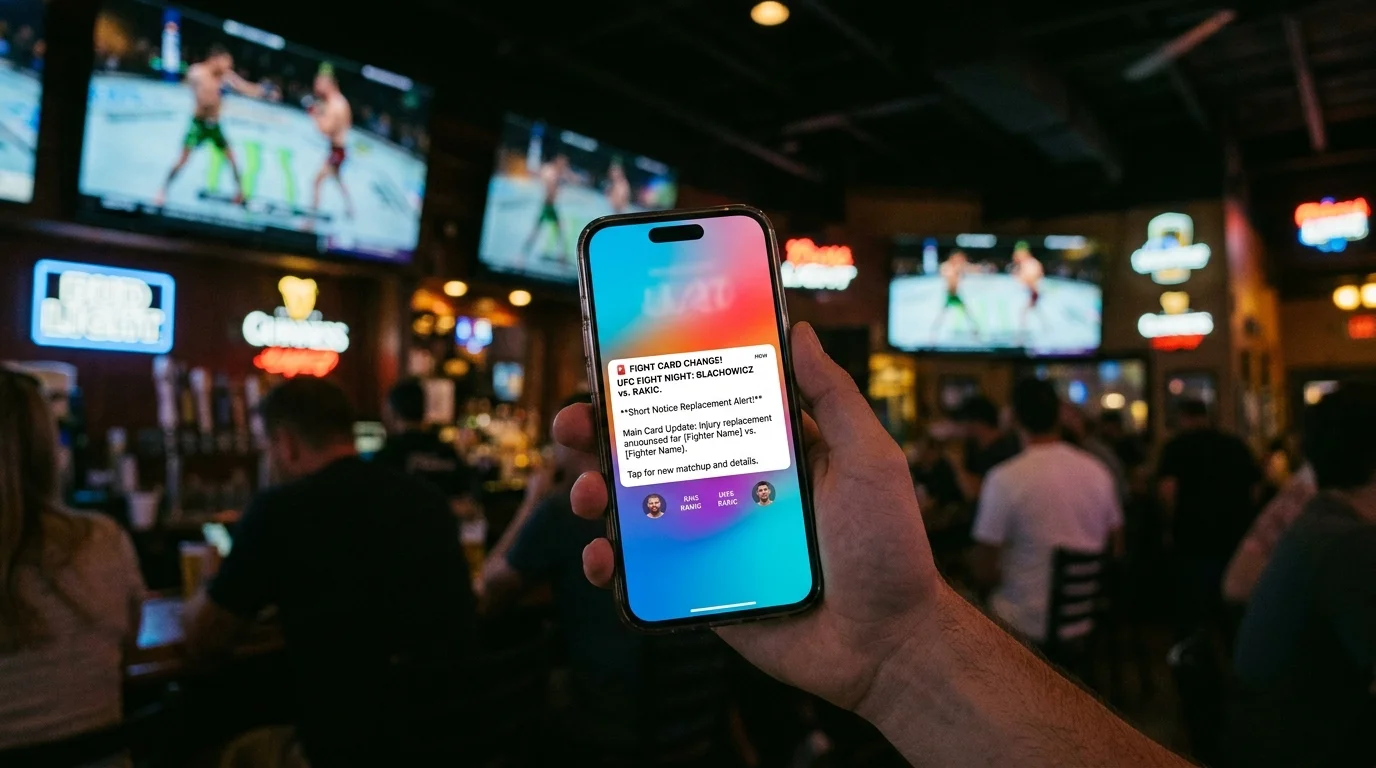
One thing that makes UFC line movement different from team sports is fight-week volatility. Weigh-in results, training camp footage surfacing on social media, and last-minute injury rumours can all move a line dramatically in the final 24 to 48 hours. I have seen a fighter’s price shift by 15% after a weigh-in where they looked visibly drained. In football or basketball, this level of individual-specific volatility simply does not exist. It makes the UFC market more reactive, more emotional, and — if you are disciplined — more exploitable.
Opening vs Closing Lines and What They Signal
The opening line is the first price a bookmaker posts for a fight, usually five to seven days before the event. The closing line is the price at the moment betting is suspended, just before the fighters walk out. The difference between the two contains more information than most bettors realise.
Opening lines are set by the bookmaker’s trading team using their internal models, historical data, and sometimes input from a small group of respected sharp bettors who are given early access. These prices are the bookmaker’s best guess before the market has its say. Closing lines, by contrast, have been refined by every dollar and pound that flowed through the market over the preceding days. They reflect the aggregated opinion of every bettor — casual and professional — who weighed in.
Research across multiple sports consistently shows that closing lines are more accurate predictors of outcomes than opening lines. The market gets smarter as more information is priced in. For UFC specifically, I have found this holds true with one important caveat: fights involving relatively unknown fighters or debutants often see wild late movement that overshoots, because the market has less data to anchor to and is more susceptible to single large bets skewing the price.
The practical application is this: if you can consistently beat the closing line — meaning the price you bet at is better than the final price — you are likely a profitable bettor over the long run, regardless of your short-term results. Closing line value (CLV) is the closest thing MMA betting has to an objective performance metric. I track it for every bet I place, and it is the single number I trust most when evaluating whether my process is sound.
For new bettors, a useful exercise is to record the opening line for every fight on a card, then check the closing line and compare. Over a few events, you will start to see patterns — which types of fights move the most, which direction they tend to move in, and how often the closing line turns out to be “right.” That pattern recognition forms the basis of more sophisticated timing strategies down the road.
See also: explore unique angles in women’s UFC betting markets.
Understanding UFC Odds: Common Questions
Why do UFC odds differ between bookmakers?
Each bookmaker uses its own pricing model, carries different liability from bets already placed, and applies a different margin. A fighter priced at 1.80 on one platform might be 1.90 on another because the second book has received less public money on that side or operates with a thinner overround. Comparing prices across multiple UK-licensed sites before placing any UFC bet is one of the simplest ways to improve your long-term returns.
What does it mean when a UFC fighter is -300?
A moneyline of -300 means the fighter is a strong favourite. You would need to stake 300 units to win 100 units of profit. Converting to implied probability: 300 / (300 + 100) = 75%. The bookmaker’s market considers this fighter roughly a three-in-four chance to win, though the actual probability may differ once you strip out the margin.
How accurate are opening UFC odds at predicting winners?
Opening odds provide a reasonable baseline, but closing odds are consistently more accurate because they incorporate all market information up to fight time. The gap between opening and closing accuracy widens for fights involving lesser-known fighters where the market has less historical data. Tracking how lines move from open to close is one of the better ways to gauge where the smart money sits.
Can UFC line movement indicate sharp money?
It can. A sudden, significant price shift without corresponding public news — no injury announcement, no weigh-in drama — often signals professional bettors placing large wagers. Reverse line movement, where the price moves against the side receiving the majority of public bets, is another strong indicator of sharp action. Neither signal is infallible, but both are worth monitoring as part of a broader analytical approach.
Created by the ”ufc Betting Tips” editorial team.