UFC Value Betting: How to Identify +EV MMA Opportunities
 Available in US
Value Betting Is the Only Sustainable Edge in MMA
In 2020, I ran a full audit of my UFC betting history — three years of data, over 600 individual wagers. The results were humbling. My win rate on individual picks was 54%, which sounds respectable until you realise I was mostly betting favourites with tight margins. My actual return on investment was negative. I was picking winners and still losing money. The diagnosis was simple: I was betting outcomes without calculating whether the price justified the risk. I was not value betting. I was just betting.
Value betting is not a strategy in the traditional sense — it is a framework that sits underneath every strategy. A bet has positive expected value, or +EV, when the probability you assign to an outcome exceeds the implied probability built into the bookmaker’s odds. Everything else — which fighter you like, how confident you feel, how dramatic the finish would be — is noise. MMA handle reached $10.3 billion in 2024, and the vast majority of that money was placed without a value calculation attached. That is the competition. That is why value betting works.
See also: sharpen your edge with a structured UFC betting strategy.
Calculating Implied vs True Probability for UFC Fights
Every set of odds carries an implied probability. Decimal odds of 2.50 imply a 40% chance. Odds of 1.67 imply roughly 60%. The formula is 1 divided by the decimal odds, multiplied by 100. If you add the implied probabilities of both fighters in a UFC moneyline, the total will exceed 100% — typically by 5% to 10%. That excess is the bookmaker’s margin, sometimes called the overround or vig. It is how they guarantee profit regardless of the outcome.
The global sports betting market is valued at approximately $125 billion in 2026, projected to reach $325 billion by 2035, and every pound of that revenue flows from bettors who collectively pay more in margin than they recoup in winnings. Your goal as a value bettor is to sit on the other side of that equation — to find fights where your assessed probability is high enough above the implied probability to overcome the margin and still leave you with a positive expectation.
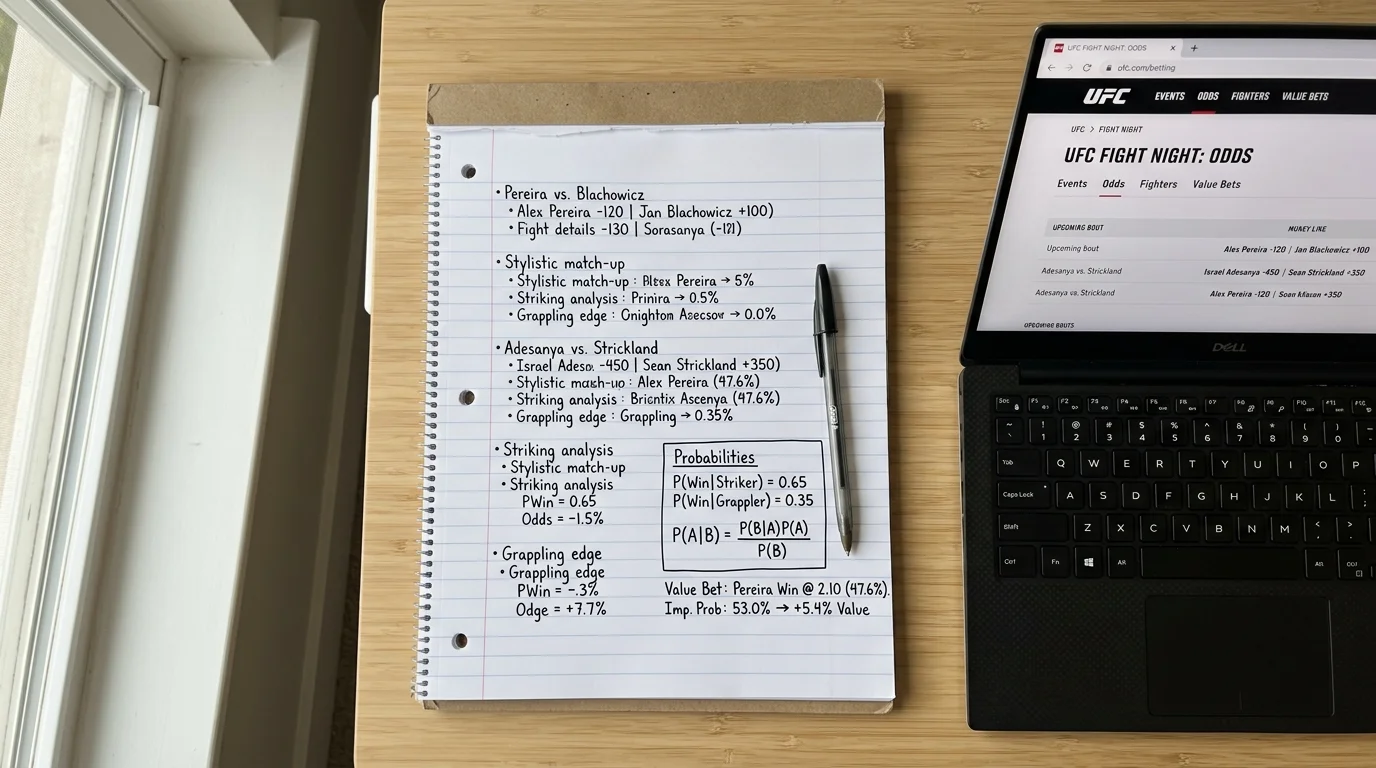
Here is a practical example. A heavyweight fight is priced with Fighter A at 1.80 and Fighter B at 2.10. The implied probabilities are 55.6% and 47.6%, totalling 103.2% — meaning a 3.2% margin. You analyse the matchup and assess Fighter B’s true probability at 54%, based on his striking accuracy, chin durability, and the fact that he has faced stronger opposition than the bookmaker’s model reflects. At 2.10, the bookmaker is pricing Fighter B at 47.6%. Your estimate of 54% creates a gap of 6.4 percentage points. That gap is the edge, and betting on it consistently over hundreds of wagers is how long-term profit is built. For the mechanics of how UFC odds translate into implied probability, that breakdown covers the full calculation.
Where MMA Bookmakers Consistently Misprice Fights
Mispricings are not random. They cluster around specific structural patterns that I have tracked across years of UFC cards. The first is division-specific finish rates that the market underweights. The heavyweight KO/TKO rate sits at roughly 50%, yet I regularly see method of victory odds on heavyweight fights that price the knockout below what that divisional baseline would suggest. The market seems to anchor on league-wide finish rates rather than adjusting fully for weight class, and that lag creates repeatable +EV opportunities.
The second pattern is the grappling discount. When a fight is marketed as a striking war — two dynamic stand-up fighters with highlight-reel knockouts — the bookmaker’s model and the betting public both gravitate toward knockout outcomes. If one of those fighters actually has an underrated grappling game, the submission and decision lines get pushed out to prices that do not reflect the true probability. Among women’s UFC finishes, 59% come by submission rather than knockout, yet casual bettors consistently overbet knockouts in women’s divisions. That disconnect between perception and data is a value bettor’s favourite territory.
The third pattern is recency bias in line-setting. A fighter coming off a spectacular first-round knockout attracts heavy public money on their next fight, pushing the line shorter than their overall body of work justifies. Meanwhile, a fighter returning from a boring decision loss against a top contender may be undervalued on their next outing against a weaker opponent. The market overreacts to the most recent performance and underreacts to the full statistical picture, and that oscillation generates value on both sides of the line.
See also: ufc betting tips for a complete guide to MMA wagering.
Value Betting as a Long-Term MMA Strategy
Value betting only works in volume. Any individual +EV bet can lose — that is the nature of probability. What matters is whether, across 100 or 200 or 500 bets, your average edge per wager exceeds zero after accounting for the bookmaker’s margin. This requires two things: accuracy in your probability assessments and discipline in your staking.
Accuracy improves with data. Track every bet you place, including the probability you assigned at the time of the wager and the actual outcome. After a sample of at least 100 bets, you can calibrate your model. If you consistently assign 55% probability to outcomes that win 50% of the time, your model is overconfident and you need to adjust. If your 55% picks win 58% of the time, your model has genuine edge and you can increase your stakes within your bankroll management rules.
Discipline means passing on fights where you do not have a clear probability assessment. A card with twelve fights might offer two or three genuine +EV opportunities and nine fights where the line is approximately fair. Betting the nine to generate action is the fastest way to erode the profits from the three. Value betting is boring by design. You spend far more time calculating and passing than you spend actually placing wagers, and that imbalance is exactly what separates it from recreational gambling.
How do I know if a UFC bet has positive expected value?
Calculate the implied probability from the bookmaker’s decimal odds using the formula 1 divided by odds times 100. Then assess the true probability based on your matchup analysis, divisional data, and fighter statistics. If your assessed probability exceeds the implied probability by a meaningful margin — typically 5% or more to account for the bookmaker’s margin — the bet has positive expected value.
Do bookmakers adjust UFC odds fast enough to close value gaps?
MMA markets are less efficient than mainstream sports like football because they attract less overall betting volume and less sharp money. Lines do move as fight week progresses, but value gaps can persist longer than in higher-liquidity markets. That said, major UFC events attract more action and tighter lines, so value is typically easier to find on Fight Night cards and preliminary bouts than on main card headliners.
Can value betting work with small UFC bankrolls?
Yes, but the timeline to realise your edge is longer with a smaller bankroll because you must stake smaller amounts per bet. Value betting relies on volume to smooth out variance, and a smaller bankroll means each losing streak takes a proportionally larger bite. Start with stakes at 1-2% of your total bankroll and focus on building a track record of accurate probability assessments before scaling up.
Created by the ”ufc Betting Tips” editorial team.