
UFC Bet Tracking: Recording and Analysing Your MMA Wagers
 Available in US
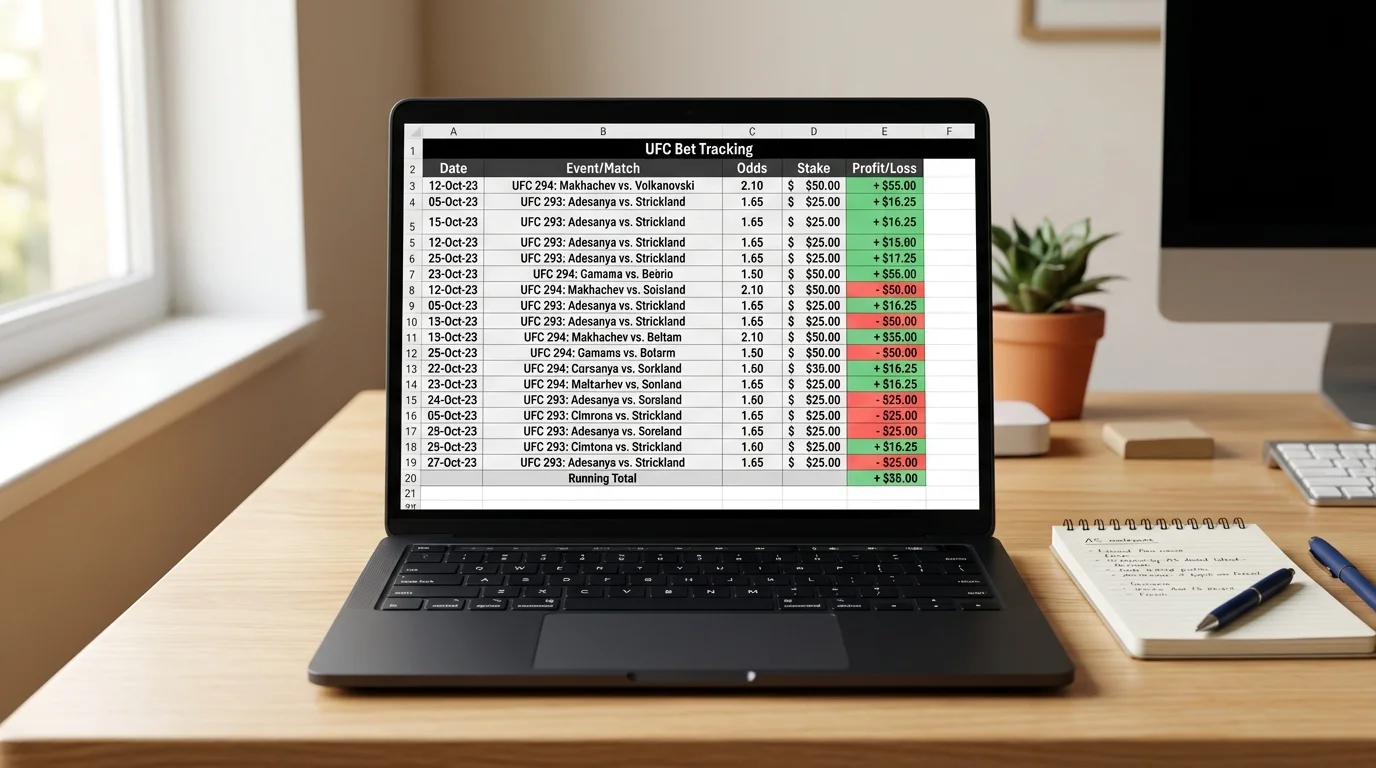
You Cannot Improve What You Do Not Measure — Especially in UFC Betting
Three years into my MMA betting career, I realised I had no idea whether I was actually profitable. I remembered the big wins vividly — the underdog knockout that paid four-to-one, the method of victory bet that landed on a third-round submission — but the losses blurred together into an indistinct haze. It was only when I started tracking every single wager in a spreadsheet that the truth emerged: I was marginally profitable on moneyline bets, significantly unprofitable on parlays, and breaking even on prop markets. Without the data, I would have continued pouring money into parlays indefinitely, convinced that my occasional big hits justified the approach.
With the MMA betting handle reaching $10.3 billion in 2024 and growing every year, the volume of UFC betting activity is enormous — but the vast majority of that handle comes from bettors who never track their results. They operate on feel, on selective memory, and on the dangerous assumption that they “know” whether they are winning. Tracking turns assumption into fact, and facts are the only foundation for improvement.
Essential Data Points for Every UFC Bet
Effective tracking requires capturing the right information at the time of the bet, not reconstructing it from memory after the event. As the DRatings editorial team notes, analytics work best when there is more data to analyse — and that principle applies to your own betting record just as much as it applies to fight statistics. The minimum dataset for each wager should cover the following fields.
Record the date, the event name, and the specific fight. Include both fighters’ names — this seems obvious, but it matters for later analysis when you want to filter by fighter, weight class, or card position. Log the market type: moneyline, method of victory, over/under rounds, prop, or parlay. For parlays, record each individual leg as a separate entry linked to the parlay, so you can later analyse which leg types contribute to parlay success or failure.
Capture the odds at which you placed the bet. This is critical because your closing line value — the difference between the odds you took and the final closing odds — is one of the strongest indicators of long-term edge. If you consistently bet at better odds than the closing line, you are identifying value before the market catches up. If you consistently bet at worse odds, you are paying a premium that erodes your edge regardless of your pick quality.
Log the stake in both monetary and unit terms. A twenty-pound bet from a two-thousand-pound bankroll is one unit; a twenty-pound bet from a five-hundred-pound bankroll is four units. The unit figure is what matters for performance analysis because it normalises your results against bankroll size. Record the outcome — win, loss, push, or void — and the profit or loss in both pounds and units.
Beyond the core fields, add contextual tags that enable pattern detection. Weight class, card position (prelim, main card, main event), whether the fight was a title bout, whether either fighter was a late replacement, and your pre-bet confidence rating on a one-to-five scale. These tags cost thirty seconds to fill in at bet time and save hours of manual analysis later. The overall UFC finish rate of fifty-three per cent means nearly half your bets will involve fights that go to decision — tagging finish type lets you later analyse whether your performance differs between stoppage bouts and decision bouts.
Spreadsheets and Apps for MMA Bet Tracking
The simplest and most flexible tracking tool is a spreadsheet — Google Sheets or Excel. A spreadsheet gives you full control over your data structure, allows custom formulas for ROI calculation and rolling averages, and costs nothing. The downside is that you must build and maintain it yourself, and the initial setup requires some comfort with basic formulas.
For the spreadsheet approach, set up columns for every data point described above, then add a summary dashboard row or sheet that calculates your overall ROI (total profit divided by total stakes, expressed as a percentage), your win rate by market type, your average odds by market type, and your monthly performance trend. A simple conditional formatting rule that highlights losing months in red gives you an immediate visual signal of drawdown periods.
Several dedicated bet tracking apps exist, though most are designed for general sports betting rather than MMA specifically. The advantage of an app is automated record-keeping and pre-built analytics. The disadvantage is that you are locked into the app’s data structure and may not be able to tag MMA-specific fields like weight class or card position without workarounds. If you choose an app, verify that it allows custom tags and exports your data in a format you can analyse independently — you do not want your entire betting history trapped in a platform that might shut down or change its pricing.
Whichever tool you use, the non-negotiable habit is recording every bet before the event starts. If you wait until after the fights to log results, you will inevitably forget some bets — usually the losses — and your record will skew optimistic. Logging at bet placement time takes the selective memory problem off the table entirely.
Using Your Data to Find Strengths and Leaks
A tracking record becomes genuinely valuable once you have fifty to a hundred logged bets — enough to see patterns emerge from the noise. Below that threshold, the sample is too small for meaningful analysis, and you should focus on building the habit rather than drawing conclusions.
The first analysis to run is ROI by market type. Most bettors discover that their performance varies dramatically across markets. You might be profitable on moneyline underdogs but unprofitable on method of victory bets, or consistently positive on over/under rounds but negative on fighter props. These patterns tell you where your analytical edge is real and where it is not, allowing you to reallocate your activity toward your strongest markets and reduce or eliminate exposure to your weakest.
Second, check your performance by weight class. The UFC’s divisional profiles differ substantially — heavyweight finishes fifty per cent of bouts by KO/TKO while lightweight sends forty-eight per cent to decision — and your betting habits may suit some divisions better than others. A bettor who excels at predicting grappling outcomes might outperform in lighter weight classes where decision rates are higher, while someone with a strong eye for power dynamics might thrive in heavyweight and welterweight. Your tracking data will reveal these patterns long before your intuition does.
Third, analyse your closing line value. For each bet, compare the odds you took with the closing odds. If your average closing line value is positive — meaning you consistently bet at better prices than the market’s final assessment — you have a durable edge regardless of short-term results. If your CLV is negative, you are systematically paying too much for your bets, and you need to either bet earlier in the week or reassess whether your perceived edge is real. Closing line value is the single best predictor of long-term profitability in sports betting, and tracking it requires nothing more than recording two numbers: the odds you took and the odds at fight time.
Finally, review your confidence calibration. If you tagged bets with a one-to-five confidence rating, check whether your high-confidence bets actually win more often and produce higher ROI than your low-confidence bets. If they do, your self-assessment is well-calibrated and you should weight your staking toward high-confidence plays. If they do not — if your five-star bets perform no better than your two-star bets — your confidence ratings are noise, and you should either recalibrate your self-assessment process or move to flat staking where every bet receives the same unit allocation.
UFC Bet Tracking Questions
What should I record for each UFC bet I place?
At minimum: date, event, fighters, market type, odds taken, stake (in pounds and units), outcome, and profit or loss. Add contextual tags for weight class, card position, confidence rating, and whether any fighters were late replacements. Record everything at bet placement time, not after the event.
What is a good ROI for UFC betting over 100+ bets?
A sustained ROI of three to five per cent over a hundred or more bets is considered strong performance for recreational bettors. Professional handicappers typically target five to eight per cent. Any positive ROI over a meaningful sample indicates genuine edge, while the majority of bettors produce negative ROI once the bookmaker margin is accounted for.
Are there free apps for tracking MMA bets?
Several free bet tracking apps exist for general sports betting, though most are not MMA-specific. Google Sheets or Excel provide the most flexible free option, allowing you to customise fields for UFC-specific data like weight class and card position. Whichever tool you choose, ensure it allows data export so your records are not locked into a single platform.
Published by the ufc Betting Tips team.