
UFC Line Movement Strategy: What Odds Shifts Reveal Before Fight Night
 Available in US
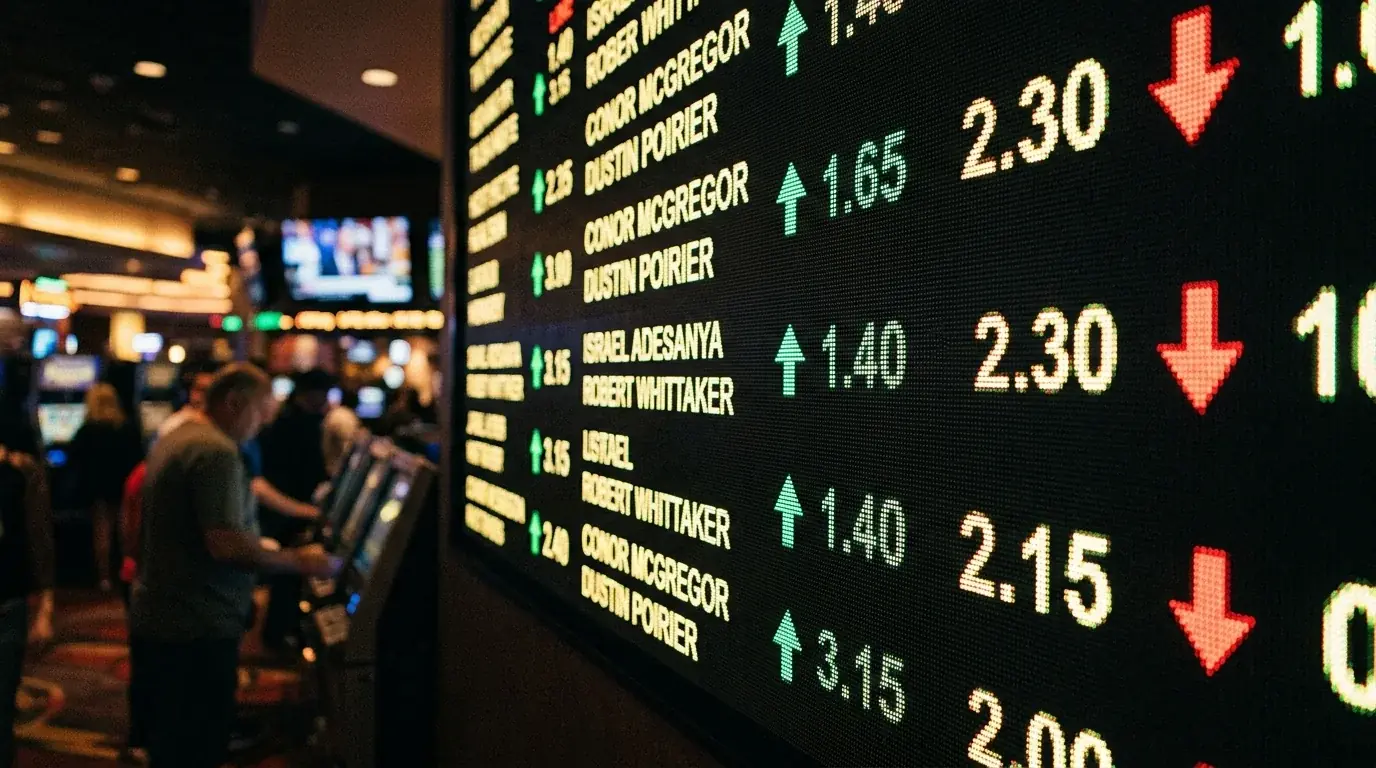
UFC Odds Don’t Stand Still — and the Movement Is the Signal
I placed a bet on a UFC underdog at +260 on a Tuesday morning. By Thursday afternoon, the same fighter was +180. I had not seen any news — no injury reports, no camp changes, nothing on social media. But someone with sharper information or a better model had moved that line by nearly a full dollar in two days. That silent shift was worth more than any breakdown I could have written, because it told me that serious money agreed with my read.
UFC odds move constantly between the moment they open and the second the cage door closes. In a market where MMA handle reached $10.3 billion in 2024, those movements are not random noise — they are compressed information. Every shift reflects money entering the market, and the nature of that money tells you something about where informed opinion sits. Learning to read line movement is not an advanced skill reserved for professionals. It is a foundational tool that separates bettors who react to odds from bettors who understand them.
The challenge is that not all movement means the same thing. A line that drifts gradually over five days carries a different message than one that snaps two full points in an hour. Decoding the difference is what this breakdown is about.
See also: use line shifts to find the best price on UFC round betting.
Steam Moves, Reverse Line Movement, and Gradual Drift
There are three primary types of UFC line movement, and each one requires a different response from your betting process. Conflating them is one of the fastest ways to misread a market.
A steam move is sudden and sharp — the line jumps significantly within minutes, usually triggered by a large wager or a coordinated wave of bets from sharp accounts. In MMA, steam moves often happen when injury information leaks before an official announcement, or when a well-known syndicate loads up on one side. You will see a fighter move from -150 to -190 inside an hour with no public explanation. Steam moves are the market’s fire alarm, and when one goes off, the information behind it is almost always material. I track steam moves across every UFC card I bet on, and the fighters on the receiving end of sharp steam win at a rate that justifies following the move — particularly when the shift happens early in the week.
Reverse line movement is subtler and more counter-intuitive. The line moves in the opposite direction of where the majority of public bets are landing. Imagine 70% of bets are on Fighter A, yet Fighter A’s odds are drifting from -200 to -180 — getting less expensive despite heavy public backing. That means the smaller number of bets on the other side carry enough weight (literally, dollar volume) to move the line against the crowd. Reverse line movement in UFC is a strong indicator of sharp action on the less popular side, and it is one of the most reliable signals I use when deciding whether to fade the public.
Gradual drift is the least dramatic but most common form of movement. The line inches a few points each day, reflecting a slow accumulation of opinion rather than any single decisive wager. Gradual drift often reflects the market finding its efficient price and is the hardest type to exploit. I generally do not act on gradual drift alone unless it aligns with my own model’s output.
Sharp Money vs Public Money in MMA Betting
The distinction between sharp money and public money is the engine behind every meaningful line move. Sharp money comes from professional bettors, syndicates, and model-driven accounts whose historical win rates justify the sportsbook adjusting its line in response. Public money comes from recreational bettors — often high in volume, low in individual size, and heavily influenced by name recognition, recent results, and media narratives.
MMA is particularly susceptible to public money distortion because the sport has a smaller and more casual betting audience than football or basketball. When a UFC main event gets mainstream attention, casual bettors flood the favourite — especially if the favourite has a recognisable name or a recent highlight-reel knockout. Bookmakers know this and set their opening lines accordingly, often shading the favourite slightly to attract public money while leaving room for sharps to exploit the other side. UFC replaced DraftKings with bet365 as its official betting partner in 2025, reflecting the sport’s growing integration with mainstream sportsbooks where recreational volume is highest.
Identifying which side the sharp money is on does not require insider access. You can track it through a combination of line movement direction, bet percentage versus money percentage (available on several odds tracking sites), and the timing of moves. Sharp money tends to arrive early in the week, when lines are softest and the value is highest. Public money peaks on fight day. If a line moves significantly between Monday and Wednesday, sharp action is the most likely driver. If it moves late on Saturday, public money is probably responsible.
I build a simple log for each fight: opening line, Monday line, Wednesday line, fight-day line. When the Monday-to-Wednesday movement contradicts the fight-day movement, sharp and public money are on opposite sides. In those situations, siding with the early-week move has been profitable over my nine years of tracking.
Using Line Movement to Time Your UFC Bets
Timing matters more in UFC betting than in most sports because the lines are thinner — less total money in the market means each significant wager moves the needle more. A bet placed at the right moment can capture two or three points of value that evaporate within hours.
My general approach is to place bets in two windows. The first is early in the week, when lines have just opened and sharp action has not yet arrived. If my model identifies value at the opening price, I take it immediately rather than waiting for confirmation from the market. The risk is that the line moves against me if sharp money disagrees, but the reward is capturing the best price available. Over hundreds of bets, the value of early pricing outweighs the occasional move in the wrong direction.
The second window is on fight day, specifically after the weigh-ins but before the prelims begin. This is when the last round of information — weight misses, visible condition changes, late injury whispers — gets priced in. If my early-week bet was on the right side, the line has usually moved in my favour by fight day, confirming my position. If the line has moved against me, I re-evaluate rather than doubling down. One of the most expensive habits in MMA betting is averaging into a losing position because you are emotionally attached to your original read.
There is a third, less common window that opens when a fight is pulled or changed. Card disruptions reset the market, and the initial re-pricing of remaining bouts often contains inefficiencies because bookmakers adjust faster for the cancelled fight than for its knock-on effects on the rest of the card.
How Pre-Fight Line Shifts Connect to Live Odds
Pre-fight line movement does not exist in a vacuum — it sets the foundation for the live odds you will encounter once the fight starts. A fighter who drifted from -150 to -200 before the bout typically opens at a steeper live price in the first round, because the market has already expressed strong confidence. Conversely, a fighter whose pre-fight line softened despite public support often carries more reasonable live odds that create in-play value if the early rounds go according to the pre-fight sharp read.
I use pre-fight line movement as a lens for my live betting. If sharp money pushed a fighter’s line significantly before the bout, and that fighter wins the first round convincingly, the live price often overreacts — making the opponent a potential live underdog value play. The market’s pre-fight confidence gets amplified by in-fight momentum, and the live odds compress beyond what the data supports.
The connection also works in reverse. If a fight opens live with odds that diverge sharply from the closing pre-fight line, it usually means in-fight information (a visible injury, a surprising style adjustment) has overridden the pre-fight model. In those situations, the live odds are reacting to something real, and fading them is dangerous. Understanding when the live market is overreacting versus correctly adjusting is the final piece of the line movement puzzle, and it comes only from watching hundreds of fights with the numbers open beside you.
See also: ufc betting tips for timing and line-shopping techniques.
UFC Line Movement Questions
What causes UFC odds to move before a fight?
UFC odds move due to money entering the market. Large wagers from professional bettors (sharp money) cause the biggest shifts, while high volumes of smaller recreational bets can also push lines. External factors like injury news, training camp reports, and weight-cut concerns also trigger movement when they change the perceived probability of an outcome.
How do I tell if UFC line movement is driven by sharp money?
Sharp money typically moves lines early in the week, before public attention peaks. The clearest indicator is reverse line movement — when the line moves opposite to the direction most bets are placed. If 70% of bets back Fighter A but the line moves toward Fighter B, the dollar volume on Fighter B’s side is likely coming from sharp accounts. Tracking opening line versus midweek line helps identify sharp-driven shifts.
Should I bet early or wait for the closing line in UFC?
Both approaches have merit depending on your strategy. Betting early captures the softest prices before sharp money moves the line, which is valuable when your model identifies clear value at the opening number. Waiting until fight day gives you more information — weigh-in results, late news — but at the cost of tighter odds. Many profitable bettors split their action between early-week and fight-day windows.
Written by the editors at ufc Betting Tips.