Best UFC Betting Sites in the UK for 2026
 Available in US
Table of Contents
- Not Every UK Bookmaker Takes MMA Seriously — Here’s How to Tell
- What Makes a Good UFC Betting Site for UK Punters
- UKGC Licensing: What It Guarantees and What It Doesn’t
- How the 2026 Remote Gaming Duty Rise Affects Your Odds
- UFC Free Bets and Promotions: What UK Sites Offer
- Account Verification and KYC for UK Betting Accounts
- Mobile Betting Apps: UFC on the Go
- UK UFC Betting Sites: Common Questions

Not Every UK Bookmaker Takes MMA Seriously — Here’s How to Tell
I opened my first UFC betting account in 2017 on a platform that listed exactly three markets per fight: moneyline, over/under 1.5 rounds, and method of victory grouped into two categories (finish or decision). That was it. No round betting, no fighter props, no bet builders. The site treated MMA like a sideshow — a few lines tacked onto their football offering because someone in the office noticed UFC was getting popular.
Nine years later, the landscape has changed dramatically, but the gap between operators who genuinely invest in their MMA product and those who merely list it has not disappeared. It has just become harder to spot. A site might offer twenty markets on a championship fight but only three on a preliminary bout. Another might have decent market depth but price everything with a 7% overround that eats your edge before you have placed a single bet.
There are 5,825 licensed betting premises across the UK as of the latest Gambling Commission data, and the remote (online) sector generates roughly £7.8 billion in gross gaming yield annually. That is an enormous market with dozens of licensed operators competing for your deposits. The question is not whether you can bet on UFC in the UK — you can, easily, legally — but which platforms give you the best chance of actually making your analysis count.
This guide is not a ranking. I am not going to tell you which bookmaker is “best,” because the answer depends on what you prioritise: market depth, odds quality, live betting speed, mobile experience, or bonus value. What I will do is give you the criteria I use after nine years of betting across multiple platforms, so you can evaluate any site yourself.
See also: combine your picks into multi-fight bets with our UFC parlay tips.
What Makes a Good UFC Betting Site for UK Punters
When UFC replaced DraftKings with bet365 as its official betting partner in 2025, it signalled something important: the relationship between UFC and the betting industry is no longer peripheral. It is central. The sport’s business model increasingly depends on betting partnerships, which means operators with official ties tend to invest more in their MMA product — deeper markets, faster odds updates, more granular props.
That does not mean an official partner is automatically the best platform for your needs. The criteria I evaluate — and the order in which I prioritise them — have been refined over hundreds of events and thousands of individual bets. What matters, in descending order: odds quality, market depth, live betting responsiveness, mobile functionality, and promotional value. The first two are non-negotiable. The rest are meaningful differentiators.
Odds quality is the single biggest determinant of your long-term profitability. A platform that consistently offers tighter overrounds — say 3-4% versus 5-6% on a competitor — will return more money to you across every bet, regardless of which fights you pick. The difference feels negligible on a single wager, but across a year of UFC betting at 100+ bets, it compounds into a substantial gap. I check overrounds on main events across four to five platforms before every card and consistently find variations of two to three percentage points between the tightest and widest books.
Market depth matters because the moneyline is not always where the value sits. Some of my most profitable bets have been on round totals, method of victory sub-categories (KO/TKO specifically, rather than grouped “finish”), or fighter props like total significant strikes. A platform that only offers moneyline and basic over/under is limiting your options to the markets where the bookmaker’s pricing is typically most efficient — and therefore hardest to beat.
Customer service responsiveness is something bettors rarely think about until a fight is cancelled, a fighter misses weight, or a technical glitch freezes your account during a live event. I have experienced all three. The platforms that resolved issues within minutes kept my custom. The one that took 72 hours to respond to a disputed void lost it permanently.
Odds Depth and MMA Market Breadth
The real test of an operator’s MMA commitment is not how many markets they offer on a title fight — everyone loads up the marquee bouts — but how many they offer on a Fight Night prelim between two unranked fighters. That is where the serious divergence appears.
A well-serviced MMA platform will offer, at minimum, the following for every fight on a card: moneyline, method of victory (with KO/TKO, submission, and decision separated), over/under rounds (typically 1.5 and 2.5 for three-round fights; 2.5 and 3.5 for five-rounders), and fight to go the distance (yes/no). Better platforms add exact round betting, fighter props (total strikes, takedowns), and same-fight bet builders.
I keep a simple scoring system. For each UFC event, I check one main card fight and one preliminary fight, count the available markets on each platform, and log the numbers. Over time, a clear picture emerges of which operators consistently deliver breadth versus which inflate their main event offerings and leave the rest bare. The platforms that score highest on undercard depth tend to be the ones where I find the best value, because less public attention on those fights means less pricing scrutiny from the bookmaker’s side.
One additional factor: how quickly do new markets appear after a fight is announced? Some operators post odds within hours of a bout being confirmed. Others wait until fight week. Early posting gives you access to opening lines — which, as any seasoned bettor knows, is where some of the widest value gaps exist before the market corrects through volume.
UKGC Licensing: What It Guarantees and What It Doesn’t
A friend of mine — a sharp bettor with a solid track record — once asked me whether UKGC licensing actually meant anything beyond a logo on the website. The honest answer is: it means quite a lot, but not everything people assume it does.
The UK Gambling Commission (UKGC) is one of the most rigorous regulatory bodies in global gambling. A UKGC licence guarantees that the operator meets specific standards for fund segregation (your deposits are protected if the company goes under), responsible gambling tools (deposit limits, self-exclusion options, reality checks), technical fairness (odds must reflect stated prices), and complaint resolution procedures. Ten percent of the UK population participates in online sports betting, and every one of them is protected by these baseline standards when using a licensed operator.
What UKGC licensing does not guarantee is competitive odds, quality customer service, or a good MMA product. The licence is a floor, not a ceiling. It means the operator is not outright fraudulent. It does not mean they are good at pricing UFC fights or that their platform is well-designed for combat sports bettors. I have used UKGC-licensed platforms with excellent regulatory compliance and appalling odds quality, and I have used others where the regulatory checkbox was met alongside genuinely competitive MMA pricing.
There is one practical implication of UKGC licensing that matters for UFC betting specifically: dispute resolution. If you believe a bet was settled incorrectly — the most common scenario is ambiguity around a stoppage call or a fight ruled a no-contest — a UKGC-licensed operator must follow a defined complaints process and ultimately submit to adjudication by an approved alternative dispute resolution (ADR) provider. I have used this process once, over a contested method-of-victory settlement, and the resolution was fair. On an unlicensed offshore platform, you have no comparable recourse.
The blunt advice: never place a UFC bet with an operator that is not UKGC-licensed. The odds might look slightly better on an offshore site, but the risk to your funds and your ability to resolve disputes is not worth the marginal price improvement. There are enough licensed operators offering competitive MMA odds that you never need to leave the regulated ecosystem.
How the 2026 Remote Gaming Duty Rise Affects Your Odds
In April 2026, the UK government raised the Remote Gaming Duty from 21% to 40%. That is not a tweak — it is nearly a doubling of the tax rate on online casino and gaming revenue, with a separate 25% rate for remote sports betting taking effect from April 2027. These changes represent the most significant shift in UK gambling taxation in over a decade, and they directly affect the price you pay on every UFC bet.
The mechanism is straightforward. When an operator’s tax bill increases, they have three options: absorb the cost (reducing profit), reduce payouts (widening margins), or pass the cost to consumers through less competitive odds. The Office for Budget Responsibility assessed the situation plainly — operators are expected to pass through roughly 90% of the duty increases by adjusting prices or reducing payouts. The government itself expects to collect £1.1 billion in additional gambling taxes by 2029-30, and most of that money will come, indirectly, from punters accepting worse odds.
What does this look like in practice? A fight that might have been priced with a 4% overround in 2025 could now carry a 5% or 6% overround at the same bookmaker. On a single bet, the difference is pennies. Across a year of UFC betting — say, 150 bets — that extra margin erodes your returns by a measurable amount. If you were breaking even before the tax change, you may now be losing slowly without changing anything about your process.
Some industry analysts, including BDO Global, have suggested that the new tax rates could lead to market exits by operators who cannot sustain profitability at the higher duty levels. If that happens, punters lose competition — and competition is what keeps odds competitive. Fewer operators bidding for your custom means less incentive to offer tight margins on niche sports like MMA.
The countermeasure is one I have been practising already: aggressive odds comparison across multiple platforms. The tax change does not hit every operator equally. Larger operators with diversified revenue streams can absorb more of the cost. Smaller specialists may pass more to the consumer. By shopping your UFC odds across four or five licensed sites before every bet, you partially insulate yourself from the margin expansion. The effort is minimal — five minutes per bet — and the cumulative return improvement is significant enough to justify it as a core part of your process.
I also expect the tax change to increase the relative value of exchange betting versus traditional bookmaker betting for MMA. Exchanges, which match bettors against each other rather than against a bookmaker, pass through a commission on winning bets rather than building a margin into the price. Their exposure to the duty increase is structured differently, and their effective overround may remain more competitive for certain fight markets. It is worth exploring if you have not already.
UFC Free Bets and Promotions: What UK Sites Offer
Every major UK bookmaker offers some form of welcome bonus or ongoing promotion, and many now include UFC events in their promotional calendars alongside football and horse racing. The question is not whether free bets exist for MMA — they do — but whether they deliver genuine value or just the illusion of it.
The most common offer types for UFC are: sign-up free bets (typically “bet X, get Y free”), enhanced odds on selected fights (boosted prices on a specific fighter), and accumulator insurance (stake returned as a free bet if one leg of a parlay loses). Each type has strings attached, and the strings are where the real maths lives.
Sign-up free bets almost always carry wagering requirements or restrictions on withdrawal. A “bet £10, get £30 in free bets” offer sounds generous until you realise the free bet stakes are not returned with winnings, which effectively halves the value. A £30 free bet at decimal odds of 2.00 returns £30 profit (not £60), because you do not get the original £30 stake back. After working through the wagering requirement, the actual expected value of most sign-up offers lands between 40% and 60% of the headline figure.
Enhanced odds promotions — where a bookmaker boosts a fighter’s price from, say, 1.80 to 2.50 — can represent genuine value if the boosted price exceeds the fight’s true probability. But they are usually capped at small stakes (often £10 or £25), which limits the total profit available. I treat these as bonus income rather than a strategic tool. If the boosted price offers +EV, I take it at the maximum allowed stake. If it does not, I ignore it.
For a more detailed breakdown of current offers and how to assess their actual value, I have put together a separate guide to UFC free bets in the UK that covers the maths behind each common promotion type.
The broader point is this: promotions are not a substitute for a sound betting process. They are a supplement. The punter who places 100 well-analysed bets per year on UFC and claims four or five genuine-value promotions along the way will always outperform the punter who chases every bonus and treats free bets as the strategy itself.
Account Verification and KYC for UK Betting Accounts
Know Your Customer (KYC) verification is mandatory for every UKGC-licensed betting operator. It is also, in my experience, the step that causes the most frustration for new MMA bettors who just want to place a bet on the next UFC card and instead find themselves uploading documents and waiting for approval.
Here is what to expect. Every UK betting site will require you to verify your identity before you can withdraw winnings, and many now require it before you can even deposit. Standard documents include a government-issued photo ID (passport or driving licence), proof of address dated within the last three months (utility bill or bank statement), and in some cases, proof of funding (a bank statement showing the source of your deposits).
The timeline varies wildly. Some operators verify documents within an hour using automated systems. Others take two to three business days for manual review. I have had one verification stuck for five days during a high-volume period around a major UFC event. The lesson is simple: do not wait until fight week to open and verify a new account. If you are planning to bet on an upcoming card, start the account setup process at least ten days in advance.
Enhanced due diligence kicks in at higher deposit or spending thresholds. If your deposits exceed certain amounts (the thresholds are operator-specific and not always publicly stated), you may be asked for additional documentation — payslips, tax returns, or bank statements covering a longer period. This is a regulatory requirement, not a bookmaker being difficult, and refusing to comply will result in your account being restricted or closed.
One practical tip: keep a folder on your phone with clear photos of your ID, a recent utility bill, and a bank statement. Having these ready means you can complete KYC on a new platform in under five minutes rather than scrambling to find documents when you should be analysing a fight card.
Mobile Betting Apps: UFC on the Go
UFC events run on Saturday evenings UK time, which means you are not always sat at a desk with a laptop when you need to place or manage a bet. Mobile is not a nice-to-have for MMA betting — it is essential, particularly for live betting where seconds matter.
The quality gap between mobile apps from different UK operators is larger than most punters realise. The best apps for UFC betting share three traits: fast odds loading (the price you see when you open the fight should be the price you get when you tap “place bet”), clean navigation to MMA markets (not buried under four layers of football menus), and reliable in-play functionality that does not freeze or crash during high-traffic moments like a UFC main event. The worst apps check none of those boxes and add a bonus of laggy bet placement that costs you critical seconds during live events.
I test mobile apps by timing the process from opening the app to having a live UFC bet confirmed. On the best platforms, that process takes under 15 seconds. On the worst, it takes over 45 seconds and sometimes requires a page refresh mid-process. That 30-second difference is irrelevant for pre-fight betting but significant for in-play markets, where odds can shift dramatically between rounds.
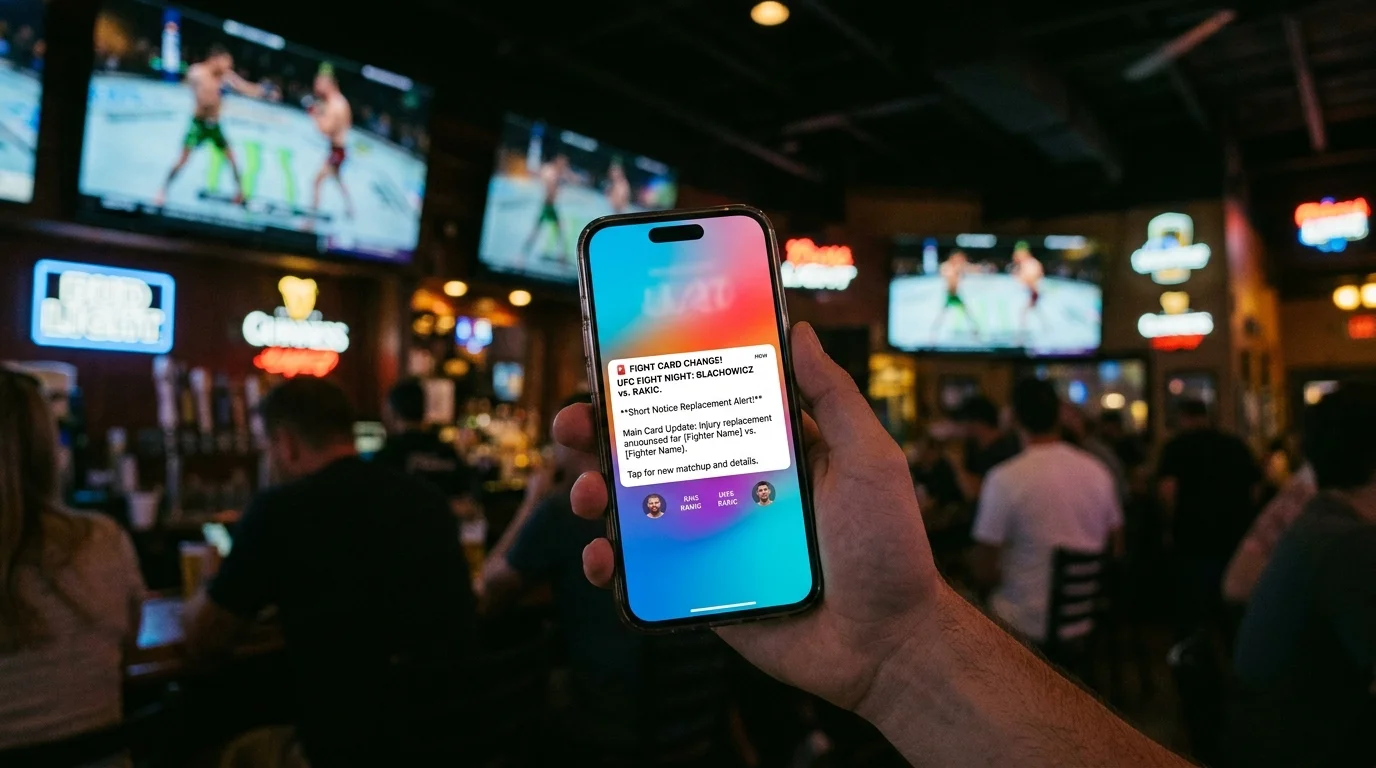
Push notifications for UFC events are another feature worth enabling. Most major UK apps now offer alerts for upcoming fights, odds changes on fighters you have watched or bet on previously, and results as they happen. These notifications are not a replacement for your own pre-event research, but they do help you stay connected to market movement on days when you are not actively monitoring the card.
A final note: download the app from the operator’s official website or the App Store / Google Play Store only. Third-party downloads are a security risk, and no legitimate UKGC-licensed operator distributes their app through unofficial channels.
UK UFC Betting Sites: Common Questions
Are there UFC betting bonuses specifically for UK punters?
Most major UK-licensed bookmakers include UFC events in their promotional calendar. Common offers include sign-up free bets, enhanced odds on selected fights, and accumulator insurance. UFC-specific promotions typically appear around major numbered events and title fights. The value of these offers varies — always check wagering requirements and stake caps before claiming.
How often do UK bookmakers update their UFC odds?
Opening odds for UFC fights are usually posted five to seven days before an event. Prices then adjust continuously as money enters the market. During fight week, odds can change multiple times per day in response to weigh-in results, injury news, and sharp betting action. On fight night itself, live odds update between rounds and during significant in-fight moments.
Which UK betting sites offer the widest range of MMA markets?
Market depth varies significantly between operators. The most comprehensive MMA platforms offer moneyline, method of victory with separated KO/TKO and submission categories, round betting, over/under rounds, fighter props, and bet builders for every fight on a card. Operators with official UFC partnerships tend to invest more in their MMA product. The best way to assess depth is to check how many markets are available on a preliminary card fight, not just the main event.
Do I need separate accounts for UFC and other sports betting?
No. Every UK-licensed betting site that offers UFC markets allows you to bet on MMA from the same account you use for football, racing, or any other sport. Your balance, deposit methods, and verification apply across all sports on the platform. Some bettors choose to maintain accounts on multiple platforms to access the best odds for different markets, which is common and entirely permitted.
Prepared by the ufc Betting Tips editorial staff.