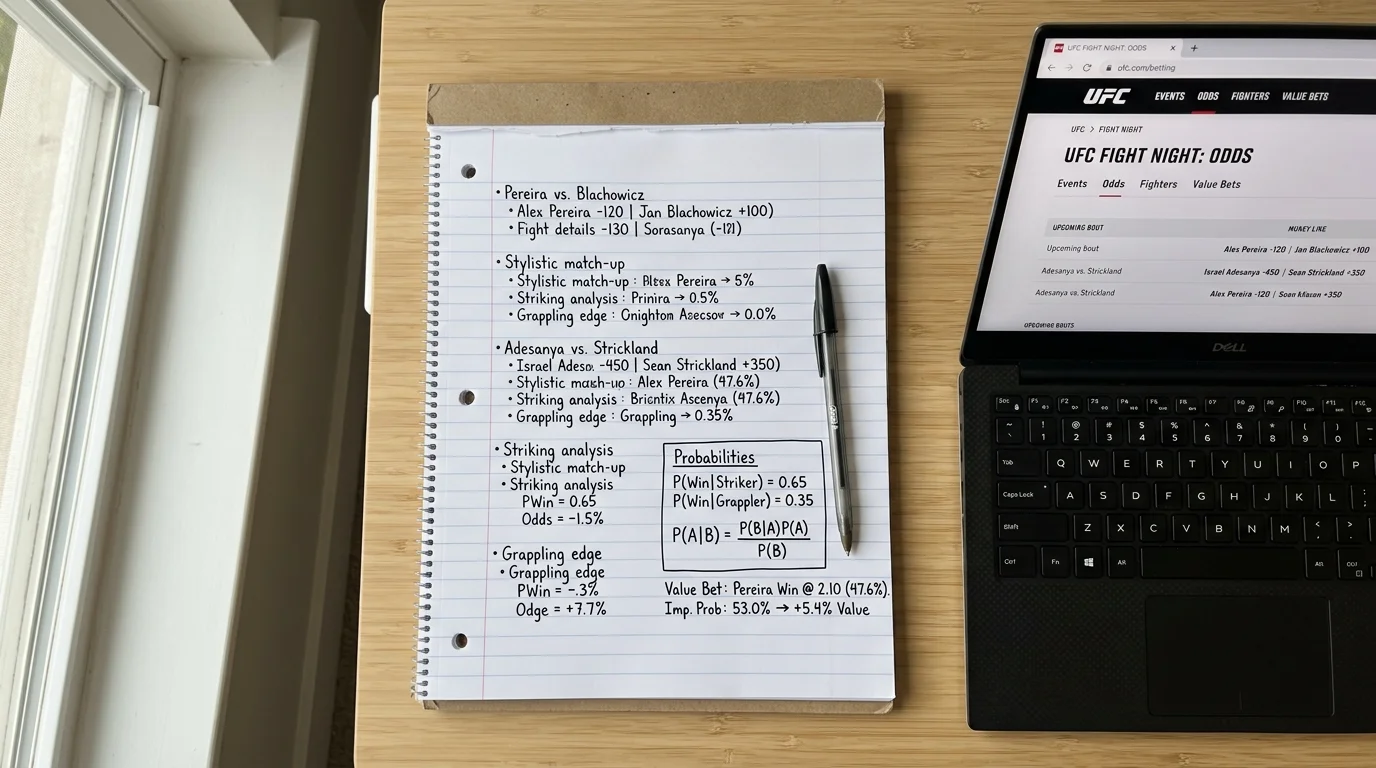
UFC Fighter Stats for Betting: Metrics That Actually Predict Outcomes
 Available in US
Table of Contents
- Every Tipster Says “Study the Stats” — Here’s Which Ones Matter
- Striking Metrics: Significant Strikes, Accuracy, and Absorption
- Grappling Metrics: Takedowns, Control Time, and Submission Rate
- How Stats Shift Across Weight Classes
- Statistical Traps: When Numbers Mislead MMA Bettors
- Where to Find Reliable UFC Statistics
- UFC Fighter Stats for Betting: Questions
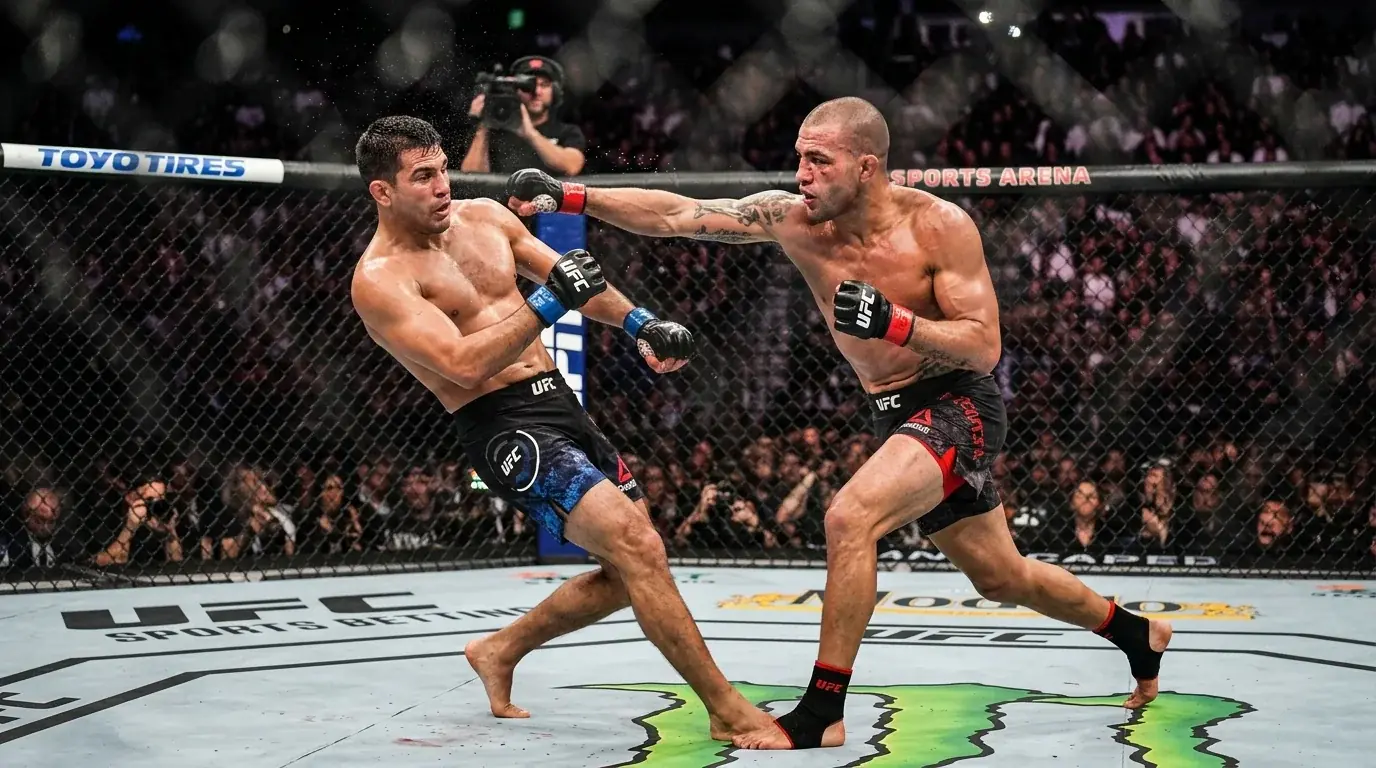
Every Tipster Says “Study the Stats” — Here’s Which Ones Matter
Open any UFC betting guide and you will find the same advice: study the statistics. It sounds reasonable. It is also useless without knowing which statistics carry predictive weight and which ones are noise dressed up in numbers. I spent my first two years tracking every available metric for every fighter on every card. The result was not better picks — it was analysis paralysis, drowning in data points that contradicted each other and left me less confident than when I started.
The breakthrough came when I stopped treating all stats equally and started asking a harder question: which metrics actually correlate with winning, and under what conditions? The answer is not a single number. It is a hierarchy that shifts depending on the weight class, the matchup type, and the context of the fight. Styles make fights, as the old saying in MMA goes — and the right statistical lens depends entirely on which styles are colliding.
Across all UFC bouts, 53% end in a finish: 33.3% by KO/TKO and 19.7% by submission. The remaining 47% reach the judges’ scorecards. That near-even split between finishes and decisions means no single category of statistics dominates across the sport. Striking metrics predict outcomes in certain matchups. Grappling metrics predict outcomes in others. The skill is not knowing the numbers — anyone with internet access can look those up — but knowing when each set of numbers applies and when it misleads.
What follows is the hierarchy I use after nine years of tracking fighter data against betting outcomes. It is not complete — no system captures every variable in a combat sport — but it has been the most reliable framework I have found for turning raw statistics into probability assessments that beat the market more often than not.
See also: learn how stats translate into prices in our UFC odds explained guide.
Striking Metrics: Significant Strikes, Accuracy, and Absorption
Significant strikes per minute (SLpM) is the metric that catches everyone’s eye first. It measures how many meaningful strikes — anything beyond light jabs and body taps — a fighter lands per minute of cage time. The number is seductive because it is easy to compare: Fighter A lands 5.2 per minute, Fighter B lands 3.8, so Fighter A is the better striker. Right?
Not necessarily. SLpM is a volume metric, and volume without accuracy or context is misleading. A fighter who throws 80 strikes per round but lands 35% of them is connecting with 28 significant strikes. A fighter who throws 50 but lands 55% is connecting with 27.5. Nearly identical output, completely different styles, and the second fighter is taking far less damage in the exchanges because they are not overextending to generate volume.
This is why I pair SLpM with striking accuracy — the percentage of significant strikes that actually land. In my tracking, fighters with accuracy above 50% outperform their implied probability in moneyline markets more consistently than fighters with high volume but lower accuracy. The accuracy metric captures precision and timing, which are harder to game and harder for opponents to neutralise than raw output.
The third piece of the striking puzzle is significant strikes absorbed per minute (SApM). This is the defensive counterpart — how much damage a fighter takes. A low SApM combined with high accuracy signals a fighter who controls distance well, picks shots, and does not get drawn into brawls. That profile tends to win decisions in technical divisions and avoid the kind of exchanges that produce upset knockouts.
The striking differential — SLpM minus SApM — gives you a single number that captures net striking effectiveness. A positive differential means the fighter lands more than they absorb. A negative differential means the opposite. I have found this to be the single most useful striking metric for quick initial assessments. If a fighter has a striking differential above +1.5 and their opponent’s is below zero, the stylistic edge in the striking phase is clear, and the odds should reflect that. When they do not, there may be value.
One caveat that matters enormously: striking stats carry hidden context that the raw numbers do not reveal. A fighter’s SLpM might be 4.0, but if three of their last four opponents were grapplers who spent most of the fight pursuing takedowns, that striking number reflects a specific kind of fight — one where the standing exchanges were brief and the opponent’s strategy was not to strike at all. Compare that same 4.0 SLpM against a run of fights against fellow strikers and the number means something entirely different. Always check who a fighter has been fighting, not just what their aggregate numbers say.
I also track knockdown rate — how often a fighter scores a knockdown per fight — as a supplementary metric. It is small-sample and noisy, but in heavyweight and light heavyweight, where single shots carry disproportionate finishing power, a consistently high knockdown rate is a genuine signal of stopping ability that SLpM alone does not capture.
Grappling Metrics: Takedowns, Control Time, and Submission Rate
If striking stats are where most bettors start, grappling stats are where the sharper ones separate themselves. The reason is simple: grappling is less visible to casual fans, less covered in pre-fight hype, and therefore less efficiently priced by the market. A fighter’s knockout highlight reel drives betting volume. Their takedown defence percentage does not. That asymmetry in attention creates asymmetry in pricing — which is where profit lives.
Takedown accuracy — the percentage of attempted takedowns that successfully land — is the grappling metric I weight most heavily. A fighter who converts above 45% of their takedown attempts controls where the fight takes place. That control dictates pace, scoring, and finish likelihood. Conversely, takedown defence — the percentage of opponent takedowns stuffed — tells you how well a fighter resists having the fight location changed against their will. A striker with 85%+ takedown defence can keep the fight standing against most opponents. A striker with 60% takedown defence is vulnerable to any competent wrestler.
Control time measures total minutes and seconds a fighter spends in a dominant grappling position. High control time correlates strongly with decision wins in my data, because UFC judges score effective grappling explicitly in their criteria. A fighter who averages three minutes of control time per fight against quality opposition is generating scorecards in their favour even when they are not landing dramatic ground strikes.
Submission rate is the grappling equivalent of knockout rate — how often a fighter finishes via choke or joint lock. In women’s divisions, this metric carries extra weight: 59% of all finishes in women’s UFC bouts are submissions rather than knockouts. A women’s fighter with a high submission rate facing an opponent with poor submission defence is one of the clearest finish-probability signals I track. The market often underprices submission finishes because they are less visually dramatic in pre-fight promotion than knockouts, which means the public gives them less attention and the odds reflect less volume.
The trap with grappling stats is sample size. Many fighters have relatively few fights with significant grappling exchanges, which makes their percentages less stable than striking numbers. A fighter with a 60% takedown accuracy across 40 career takedown attempts is far more reliable than one with 75% accuracy across eight attempts. I apply a minimum threshold of 15 career takedown attempts before I trust the accuracy number, and even then I weight the most recent fights more heavily because grappling skills — particularly takedown defence — tend to improve or deteriorate more noticeably over time than striking fundamentals.
See also: ufc betting tips for stat-driven fight analysis.
How Stats Shift Across Weight Classes
The first time I ran my fighter database filtered by weight class instead of looking at aggregate UFC numbers, the patterns that emerged changed how I assess every fight. The differences are not marginal — they are structural, and ignoring them is one of the most common errors in MMA betting analysis.
Heavyweight is the division of extremes. Roughly 50% of bouts end in KO/TKO, and only 28.6% reach the judges. Every statistical trend you observe at heavyweight is compressed by the constant threat of fight-ending power. A heavyweight fighter’s striking accuracy matters more per exchange than in any other division, because each connected shot carries a higher probability of ending the contest. Defensive metrics — SApM and head movement effectiveness — are correspondingly more predictive at heavyweight than at lighter weights. A heavyweight who absorbs even slightly more than average is significantly more likely to be stopped.
At lightweight — arguably the UFC’s deepest and most talent-dense division — 48% of fights go to decision and KO/TKO drops to 29.1%. The stats that matter here shift toward volume, cardio, and consistency. Fighters who maintain striking output across all three rounds tend to win decisions. Those who fade in the third round, even if their first-round numbers are elite, lose close fights on the scorecards. I track round-by-round output differentials for lightweights specifically, because the decision rate makes late-fight performance a genuine predictor rather than a footnote.
Women’s strawweight is the statistical outlier that most bettors overlook entirely. With a 66.9% decision rate — the highest of any UFC division — and a finish profile dominated by submissions rather than knockouts, the metrics that predict outcomes here are fundamentally different from the men’s divisions. Control time and takedown defence become primary predictors. Striking differential matters less because fewer fights end in striking stoppages. I weight grappling metrics roughly 60/40 over striking when analysing women’s strawweight, which is nearly the inverse of my heavyweight weighting.
Middleweight and welterweight sit between the extremes, with balanced finish-to-decision ratios that make them the hardest divisions to apply a uniform statistical approach to. For these divisions, I lean most heavily on matchup-specific analysis rather than divisional benchmarks: what does this specific fighter’s statistical profile predict against this specific opponent’s weaknesses? The answer varies fight by fight more than in divisions with clearer structural tendencies.
The practical application is this: before you open a fighter’s stat page, first note the weight class. Then filter your expectations accordingly. A 40% striking accuracy at heavyweight has completely different implications than the same number at flyweight. Context is not a bonus — it is the prerequisite for all meaningful statistical analysis in MMA betting.
Statistical Traps: When Numbers Mislead MMA Bettors
Numbers do not lie, but they mislead constantly if you let them. After nine years of building fighter models, I have a growing list of scenarios where the data says one thing and the fight produces something completely different. These are not random flukes — they are systematic traps that the statistics create.
The first trap is career averaging. A fighter’s career stats include every bout they have ever had in the UFC, including fights from five, six, seven years ago when they were a completely different athlete. A 34-year-old veteran’s striking output from age 27 tells you almost nothing about their current capability. As the DRatings editorial team notes, analytics work best with more data — but stale data is worse than no data. I weight the last three to four fights far more heavily than career averages, and I discard anything beyond 24 months unless the fighter has been inactive.
The second trap is opponent quality blindness. A fighter who has accumulated impressive stats against a sequence of weak opponents will look elite on paper and vulnerable in the cage when they face a genuine step up in competition. I check the rankings and records of a fighter’s recent opponents before trusting their numbers. A 55% striking accuracy against three fighters who are no longer on the UFC roster is a very different signal than the same accuracy against three ranked contenders.
The third is survivorship bias in finish rates. A fighter with five knockouts in their last six fights looks like a devastating finisher. But if four of those knockouts came against opponents with known durability problems — fighters with high SApM who have been stopped multiple times — the finish rate is inflated by matchmaking rather than reflecting genuine stopping power. I cross-reference a fighter’s finishes against their opponents’ durability profiles to separate real finishing ability from favourable scheduling.
The fourth trap is confusing activity with effectiveness. A fighter might lead a bout in total strikes landed but lose every round because their strikes carried no weight — arm punches, kicks to the thigh that scored on the stat sheet but never threatened the opponent. UFC judging criteria explicitly prioritise damage and effective striking over volume, but the stat sheet does not distinguish between a jab that grazes the guard and a hook that buckles the knees. Watching actual fight footage — even selectively, focusing on the last two to three rounds of a fighter’s most recent bouts — is an irreplaceable complement to statistical analysis.
The fifth is ignoring stylistic context entirely. A wrestler who fights another wrestler will produce a striking-heavy stat line because neither fighter can execute their preferred gameplan. A striker who fights another striker may end up in grappling exchanges they normally avoid. Stats generated in unusual stylistic contexts are less predictive of future performance than stats generated in matchups that resemble the upcoming fight. I always ask: “Did this fighter’s recent opponents force them to fight in a style similar to what their next opponent will demand?” If the answer is no, the recent stats lose weight in my model.
Where to Find Reliable UFC Statistics
I get asked about data sources more than almost any other topic, and the honest answer is that no single platform gives you everything. The UFC’s own stats portal — available free on the UFC website — is the foundation. It tracks significant strikes, takedown accuracy, control time, and submission attempts for every fighter across every UFC bout. The numbers are official, updated promptly after events, and granular enough for most analytical purposes. Start there before paying for anything.
For algorithmic projections and Elo-style ratings, DRatings provides a free model that ranks fighters and generates win probabilities. Their system is transparent about its methodology and carries a useful disclaimer that analytics work best with larger data sets — worth remembering when you are looking at a fighter with only three or four UFC bouts. I use DRatings as a sanity check against my own assessments rather than as a primary source.
FightMetric — the company that supplies official UFC statistics — publishes its data through several media partners. ESPN’s MMA section carries FightMetric data in fighter profiles and post-fight breakdowns. The numbers are the same as what appears on the UFC site, but the presentation sometimes includes additional historical context and comparison tools that are useful for quick matchup analysis.
For round-by-round breakdowns and trend analysis, you need to do some manual work. I maintain my own spreadsheets pulling from the UFC stats portal after each event, filtering by recency and weight class. This takes roughly 30 minutes per card and produces the kind of filtered, context-specific data that no free platform generates automatically. If you are serious about statistical MMA analysis, building your own dataset — even a simple one — is the single highest-value investment of your time.
Paid services exist, and some are worthwhile. Fightomic and similar analytics platforms offer deeper statistical breakdowns, visualisations, and predictive models. Whether the subscription cost is justified depends entirely on your volume. If you are placing one or two bets per card, free sources are sufficient. If you are analysing every fight on every card, the time savings from a structured platform pay for themselves within a few months.
UFC Fighter Stats for Betting: Questions
How do I analyse UFC fighter stats for betting purposes?
Start with the UFC’s official stats portal and focus on four core metrics: significant strikes landed per minute, striking accuracy percentage, takedown accuracy, and strikes absorbed per minute. Compare these numbers between the two fighters in a matchup, then filter by weight class and recency — the last three to four fights carry far more predictive weight than career averages. Cross-reference your statistical assessment with at least one round of fight footage to confirm that the numbers reflect the fighter’s current style and ability.
Which single stat is the best predictor of UFC fight outcomes?
No single statistic reliably predicts outcomes across all divisions and matchup types. However, if forced to choose one, strikes absorbed per minute (SApM) is the closest to a universal predictor. Fighters who absorb significantly more damage per minute than their opponents lose more often, and the correlation holds across weight classes. Low SApM combined with high striking accuracy is the statistical profile most consistently associated with winning.
Are recent fight stats more reliable than career averages?
Yes, significantly. A fighter’s last three to four bouts are far more predictive than their career-long averages because fighters evolve — they change camps, develop new skills, slow down with age, or recover from injuries. Career averages include data from years ago when the fighter may have been a fundamentally different athlete. Weight the most recent 18-24 months of data most heavily and treat anything older with caution.
Where can I find free UFC fighter statistics?
The UFC’s official website publishes detailed fighter statistics including significant strikes, takedown rates, control time, and submission attempts — all free and updated after each event. DRatings offers free algorithmic projections and Elo-style fighter ratings. ESPN’s MMA section also carries official FightMetric data with additional historical context. For the most useful analysis, combine these free sources with your own filtered spreadsheet tracking recent performance by weight class.
Published by the ufc Betting Tips team.